


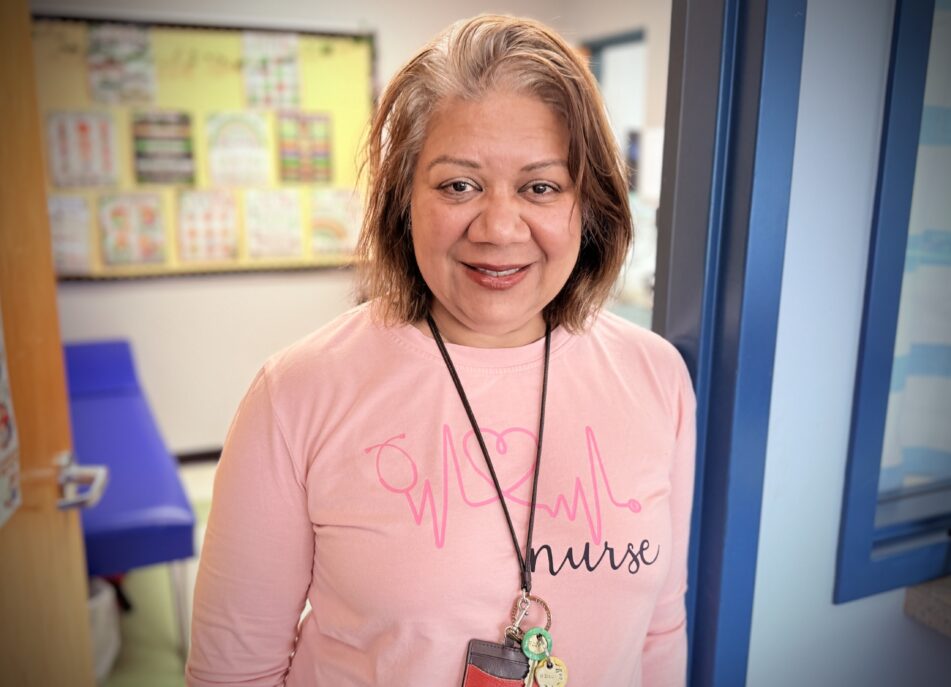
Sharon Jakob was born in Guyana, South America, and immigrated at the age of three to Canada, where she was educated and completed her Registered Nursing degree. She immigrated to the United States shortly after graduating and worked in Florida. She and her husband, who is also from Canada, made Florida their home for about 20 years, and both of their children were born there.
She and her husband moved to Michigan nearly 16 years ago.
“When I learned that Nurse Sharon Jakob was being highlighted, I was absolutely delighted,” said Huron High School Nurse Patrice Gage.
“Sharon is truly exceptional,” said Gage. “She finishes the race running alongside you, always going the extra mile for students, families, staff, and her fellow nurses. She’s the voice of our nurse group, gifted at expressing ideas and emotions in such a clear and beautiful way that she helps open vital lines of communication.”
She said Jakob cares deeply for the hearts of everyone she meets, always striving to make things better. “She has guided and mentored many of us—both formally and informally—and is the ‘go-to’ person whenever there’s a question, need for clarification, or uncertainty about next steps., “She is an exceptionally knowledgeable nurse who practices at the highest standard, demonstrating a deep love for the profession and its best practices. Sharon exemplifies the principles we’re taught in nursing school—skilled, compassionate, and committed.”
“Beyond her professional excellence, Sharon is a bright light with a strong faith and an unwavering dedication to making her school community better. She consistently sets the bar high and inspires those around her to do the same.”
What inspired you to become a school nurse, and how has your perspective evolved over the years?
I became a school nurse 10 years ago. I’ve always wanted to move into community-based nursing, and I’ve always had great respect for educators. When this job became available, I thought it would be a great opportunity to practice nursing and support our educators at the same time. I was pretty naive about what school nursing involved. It surprised me how relevant and necessary nursing care is to help get and keep kids in school. Attendance has become a big issue post-COVID, and school nurses really make a difference in supporting kids when they are struggling to be in the learning environment.
Also, I really didn’t realize how many medically impacted students are mainstreamed into our schools as well. Through the years, there has been quite an increase in medically complex situations. I’ve seen how medical advances and technology have made it possible for these medically involved students to attend school and learn along with their peers, when not so long ago, this was not possible. Nursing helps make this happen by providing direct care and indirect care through staff training and care planning.
What does a typical day look like for you, and how do you balance routine care with unexpected situations?
A typical day is centered around the predictable routine duties such as medicine management, daily lunch meds, routine skilled nursing duties, type 1 diabetes support, and general first aid for bumps and scraps, health care planning, attending team and parent meetings, field trip health support planning, to name a few.
A typical day, however, can give way to unexpected situations very quickly when you consider how many people (staff, visitors, and students) we intersect with and how much time is spent together in the school building. We can find ourselves dealing with life-threatening and urgent situations more often than you’d think. If the school nurse is present in the building, it requires reordering priorities to attend to the most critical need. This results in some pivoting and delegating of duties to other team members in order for the nurse to triage, assess, and provide interventions based on their assessment. We have these amazing individuals who make up our school MERT teams (Medical Emergency Response Teams). They are school staff who are CPR, AED, and first aid trained, who can provide health support in an urgent situation, with or without the nurse being present in the building. A nurse is always reachable for consultative support, but these teams are invaluable to our schools.
In your experience, how has the role of a school nurse changed over time?
So many more complex medical conditions and a significant increase in mental health crises really necessitate an increase in the presence of an RN in our school buildings.
What are some of the most common health concerns you see among students today?
I am noticing how our students, at least in the middle school setting, are really being impacted by the digital influences of technology. The effects are profoundly impacting all aspects of their lives- mental health (anxiety, depression, isolation), development of social and emotional appropriate behaviors, lack normal peer interaction and problem solving, lack physical activity, have poor sleeping habits, poor nutrition, engage in risky online behaviors, and have to combat the addictive nature of phones and video games in general. It really is robbing our children of normal childhood experiences.
How do you build trust with students, especially those who may be anxious or reluctant to seek help?
Just being authentic and approachable. Being willing to listen and validate, yet find the balance of challenging a growth mindset.
Can you share a moment in your career that reaffirmed why you chose this profession?
I had a moment about halfway through my time in the district where, directly through my work, I was able to help a student with housing instability and a major medical condition get reestablished with a specialty health care team. Through this connection and nursing support in the school environment, we were able to provide stability for food, housing, and get a medical procedure to reverse a tracheostomy. This had a huge impact on this child’s future medical picture and improved the quality of life. To know that you were pivotal in making this happen for a child and family is humbling and very impactful.
How do you collaborate with teachers, families, and administrators to support student well-being?
We impact attendance all around by helping kids with health needs come to school and help keep them in school by putting in the support to help them function safely and competently. This may involve a plan for short or long term, putting in the appropriate interventions to ensure health stability and training staff to meet those needs.
What role do school nurses play in supporting students’ mental and emotional health?
By creating an open and warm place to land when they need to step away and take a break. Also, I often notice recurring visits and symptoms of some students and can identify early signs of building patterns of heightened anxiety and out-of-control feelings. I can then collaborate with the guidance counselors and parents, and we can present our findings and create a plan to best support these students.
What advice would you give to someone considering a career in school nursing?
Be prepared to think outside the box and work autonomously. We work in a very different setting than a health care system that speaks the same language and has processes that support health delivery. In the school setting, the nurse is often the only person who delivers episodic health care in a pool of lay people, more or less. We have to be comfortable with our assessment skills and apply the nursing process within the scope of school nurse practice.
We are not an urgent care, and we have very limited tools in our tool belt to provide urgent interventions. Our role, however, is very impactful in that we are embedded in the routine daily life, always seeing and assessing. As a result, early identification is something that we are a key player in. We help identify issues as they are happening and can recommend a visit with the student’s health care providers to help support them further.
What continues to motivate and inspire you after 10 years in the field?
Ten years have passed! Some days and some years are exhausting, but often each day resets with a new set of dynamics from building to building or from day to day in the same building. I am motivated by seeing a student’s life changed for the better, knowing that often my presence is the support and eyes they need to steady them as they adjust and integrate their health condition into normal routines and function.
How do you spend your summers?
Recovering from a very fast-moving, intense year, especially the last quarter, where things really fast forward to an abrupt end. I love to spend time catching up with family and friends, traveling, self-care and home projects.
What about you would surprise even co-workers who know you well?
I’m a bit of a disco diva, I have to admit 🙂 The Bee Gees are my jam!
Be the first to comment