


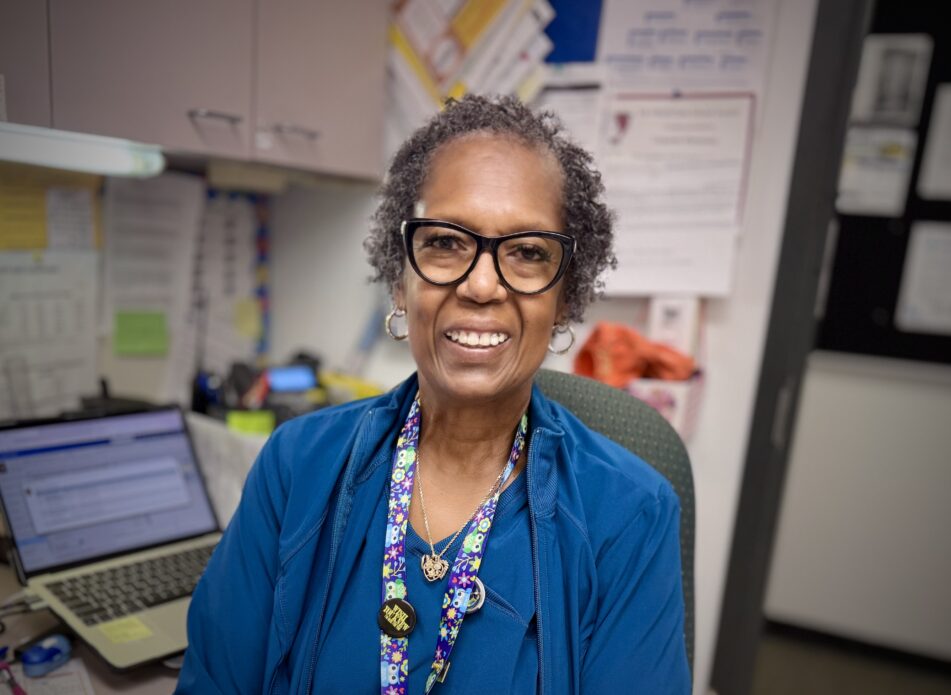
Marietta “Nurse Rita” Brooks-Hayward was born and raised in Detroit. She is one of four children on her mother’s side of the family and one of nine on her father’s.
Brooks-Hayward began her nursing career after earning an associate degree in nursing from St. Clair County Community College in 1977. She worked at Port Huron Hospital during her first year as a nurse before moving to Ann Arbor in 1978. She later earned her bachelor’s degree from Madonna University in 1993.
Soon after moving to Ann Arbor, Brooks-Hayward joined the University of Michigan Medical Center, where she spent 40 years building a distinguished nursing career. During her first 18 years, she worked in pediatric rehabilitation, trauma, and orthopedic surgery. She then spent the next 18 years as a case manager, working with patients receiving thoracic, cardiac, gastrointestinal, and plastic surgery.
Brooks-Hayward lives in Willis with her husband, Michael, whom she married one year ago. She is the mother of two children. Her son, Reginald Harling, who passed away in 2021, dedicated 21 years to AAPS as a teaching assistant at Bach, A2 Open, Allen, Angell, and Eberwhite. After earning his master’s degree in special education, he joined Lincoln Consolidated Schools. Her daughter, Donna Battle, is a resource room teacher with Ypsilanti Community Schools.
After four decades of nursing at the University of Michigan Medical Center, “Nurse Rita” continues her commitment to caring for children as the school nurse at Carpenter Elementary School.
Carpenter Principal Michael Johnson says she has a gift for making children feel safe, cared for, heard, and valued.
“Nurse Rita understands that when a child walks into the health office, they may be experiencing much more than a physical concern,” says Johnson. “They may be scared, worried, uncomfortable, or simply in need of someone who will take the time to listen. Nurse Rita meets each child with patience, compassion, dignity, and genuine care. She is truly one-of-one!”
What inspired you to become a school nurse, and how has your perspective evolved over the years?
After six months of retirement I decided I’d was not for me. I began working at a camp for special needs children and adults twice monthly for respite weekends. I was still not happy. I had more to give. I was recruited by an agency that asked if I was available to cover a temporary assignment with AAPS. I accepted. After the assignment was over I was offered a contingent position which I kept until COVID hit.
When schools reopened I accepted a position under a grant for COVID tracking which ran until the end of the school year. I was then offered a two day/week position for the 22-23 school year at Carpenter Elementary, where I remain today.
What does a typical day look like for you, and how do you balance routine care with unexpected situations?
My typical day is often predicated upon the time of the year. If it’s warm, I see minor injuries from falls off playground equipment or from sports during recess. In the winter its slips and falls on ice and snow. I see students with pink eye and strep throat as the school year progresses. I occasionally have to deal with head lice or bed bugs.
With changes in the weather, the viruses start, and they run rampant through the school. It seems like every classroom has its own epidemic! I see more bloody noses in the winter because the air is so dry. The students with asthma have exacerbations, requiring more frequent use of their rescue inhalers.
In your experience, how has the role of a school nurse changed over time?
Given that I have only a six-year perspective, I can share only the changes I have seen since becoming a school nurse. I think the biggest one is that we now have to document treatments or visits that students on Medicaid make, so Medicaid can be billed. Also, our responsibility for MICR, the Michigan immunization record-keeping system, has increased. We are definitely seeing more medically fragile children in general education, as well as students with special needs.
What are some of the most common health concerns you see among students today?
The common health concerns that I see are severe allergies, usually to nuts or milk, that are life-threatening and require that EpiPens be stored at the school in case a student is exposed. By and large, I see a great number of students with asthma. How often I use an EpiPen is greatly overshadowed by children with asthma needing their rescue inhaler.
How do you build trust with students, especially those who may be anxious or reluctant to seek help?
I always make sure the decor in my clinic is friendly, inviting, and elementary-school-centered. When a student comes to see me, I listen to them. I stop what I am doing and make eye contact. I show them that I am approachable and I want to do all I can to help them. When I see a student in the hallway, and they greet me, if they want to hug me, they get one.
Can you share a moment in your career that reaffirmed why you chose this profession?
Being that I have been a nurse for 49 1/2 years, I can’t count how many moments that reaffirmed why I chose nursing. I think overall, seeing the smile of a child whom I have helped is why I do what I do. I have friends who are just totally amazed that I came out of retirement to do this work. I just love children and want to make sure that those I can help get what they need.
Sometimes a student just wants a moment to breathe. I often am able to recognize that they’re not sick. They just need a moment. I’ll offer them an opportunity to just sit in the clinic. If they want to talk about it, I listen; if they don’t, I give them 15 minutes of quiet time. I tell them at the beginning that they have to return to class after 15 minutes. Often, this is sufficient to remedy the situation. Sometimes even little ones just need a moment to exhale and pull it all together.
How do you collaborate with teachers, families, and administrators to support student well-being?
At the beginning of the school year, I confer with the teachers based on what I pull from PowerSchool regarding a student with health concerns. Often, teachers come to me because there’s nothing in PowerSchool to inform me of a student’s potential social, emotional, or physical needs.
Otherwise, I try to connect by providing a learning experience for the students. I have talked about handwashing to the young 5s class. I read them a book concerning washing your hands. I have talked to other students about staying safe and being careful during recess.
This year, I am so excited to be holding a Teddy Bear Clinic in early November. I will have assistance from students from the School of Nursing at U of M and two students from the U of M Dearborn campus. The clinic will be for the kindergarten classes and the young five class. The topics will center around healthy habits, such as eating healthy, adequate sleep, oral care, screen time, and safety. How the students will receive this information is by bringing their teddy bear to the clinic to be “examined.“ Each station will have a single topic. The student will go through each station. At the end, they will receive a “swag bag.” Inside will be different items related to what was presented at each station, such as a toothbrush and toothpaste.
There will be age-appropriate information on eating healthy, exercise, and going to bed on time. There’ll be a healthy snack, including a little toy, coloring book, and crayons. They will also receive a certificate stating that their teddy bear or whatever stuffed animal they bring was successfully examined in the teddy bear clinic and found to be healthy. They will also have a photograph, holding their teddy bear and their certificate. I hope the children take this information home to share with their parents. A letter will go out prior to the clinic to encourage parents to have their student share what they learned.
What role do school nurses play in supporting students’ mental and emotional health?
What advice would you give to someone considering a career in school nursing?
School nursing is definitely not a profession for lack of a better term, sissies! In the hospital, if there is an emergency, you have the backup of many medical people. At school, it might just be you and maybe your MERT team. Everyone is looking at you for the answer to the question, so you must have a lot of experience with dealing with emergencies quickly and be able to keep your wits about you.
What continues to motivate and inspire you after such a long career?
May of 2027, it will be 50 years since graduating from nursing school. What motivates and inspires me are the children. I don’t consider my nursing career a profession; I feel like it is a gift from God. I was not one who dreamed of being a nurse. I was a single parent of two little ones. I needed a profession that would support my children and me. It turns out that it was the right profession, and I enjoy it immensely.
How do you spend your summers?
My summers are spent gardening. I love flowers and as many different colors as I can find. I also love reading, golfing (novice), and walking for exercise. These past two years have been spent moving, my husband relocating from Chicago and decorating my new home. I finally have the last room completed and the new gazebo built and finished. Next summer will be for gazebo sitting, reading, and, what I love most, traveling.
What about you would surprise even co-workers who know you well?
They would be surprised that I love snakes! I will pick one up if it’s not poisonous, and I am not afraid of bugs and spiders.
Be the first to comment