



By Jo Mathis/AAPS District News
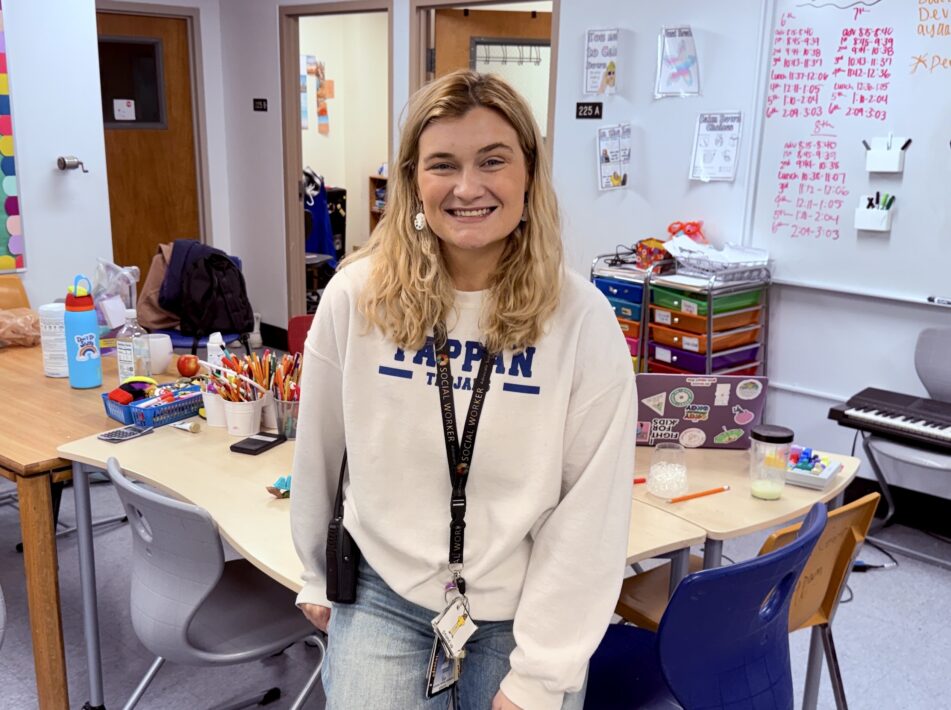
Kaylee Keena grew up with a younger brother in Fremont, Michigan, where her parents still reside. Growing up in a small farming community, it wasn’t uncommon for her friends to drive their tractors to school. She says those roots instilled in her a strong sense of community, hard work, and connection.
While attending Fremont High School, Keena dual-enrolled and began taking psychology courses. During that time, she realized she wanted to pursue a career where she could be more hands-on in helping others. When a professor suggested social work, she remembers thinking, What even is that? After researching the field and learning more about the impact social workers can have, Keena knew she had found the right path.
Keena attended Ferris State University, where she completed her Bachelor’s degree in Social Work with a minor in Philosophy. During her three years at Ferris, she worked as a Youth Specialist at Eagle Village in Hersey, Michigan, a residential facility that supports youth involved in the foster care and juvenile justice systems. She says that working with youth ages 7–17 provided Keena with invaluable experience in crisis management, relationship-building, and maintaining healthy professional boundaries, and most importantly, it strengthened her passion for advocating for and supporting young people during some of the most challenging seasons of their lives.
The final chapter of Keena’s educational journey brought her to the University of Michigan, where she pursued her Master’s in Social Work. While there, she had the opportunity to intern with Ann Arbor Public Schools, including Tappan Middle School. It was during this experience that Keena discovered her passion for working with students in their natural environment—the school setting.
She says that schools provide a unique window into a child’s world and allow for a more comprehensive understanding of the whole child.
Tappan Principal Tyese Parnell says the school is incredibly lucky to have Keena in her third year serving as a school social worker.
“She truly loves her work and deeply cares about the students and staff she supports every day,” says Parnell. “Kaylee’s dedication to ensuring that every student feels supported and valued helps make our school a safe and welcoming place for all. Her smile is infectious, her energy unmatched, and her passion for working with students is hard to put into words.”
What are some of the most common challenges you help middle school kids work through?
Middle school students experience a variety of daily challenges, including conflict resolution, self-regulation, self-esteem concerns, feeling wronged by peers, and learning how to advocate for themselves. At this age, students are still developing the skills to effectively express and manage their big emotions, which can sometimes lead to misunderstandings or heightened conflicts. To support their growth, I facilitate at least one restorative practice conversation each day to help students process situations, repair harm, and build stronger communication and problem-solving skills.
What strategies do you use to help children feel comfortable opening up to you?
I believe in meeting students where they are, approaching each interaction with an open mind and an open heart. I incorporate play and talk therapy strategies to create a safe, supportive space where students feel comfortable expressing themselves. Through a good sense of humor, active listening,
providing intentional wait time, and genuinely connecting to their interests, I help students feel heard, valued, and understood.
How do you work with teachers and families to support a child’s social and emotional needs?
I implement a check-in/check-out system to support student growth and accountability. Teachers complete goal-tracking forms each hour to monitor whether students are meeting their individualized goals, which allows students to earn incentives. This system promotes motivation, self-awareness, and
consistent feedback throughout the school day.
In addition, I connect families with resources beyond the school setting, including referrals for outside therapy, housing support, food assistance, and other community-based services. Within the school environment, I develop individualized break plans and provide classroom push-in support to help students regulate their behavior and successfully access instruction.
What’s the most rewarding part of your job?
One of the most rewarding parts of my work is watching students grow and become the best versions of themselves. Middle school can be such a pivotal and challenging transition period. I remember it being one of the hardest stages during my own childhood. Because of that, it is incredibly meaningful to support my students as they navigate academic, social, and emotional challenges. Seeing them build confidence, develop maturity, and experience success makes this work truly fulfilling.
What’s the most challenging?
One of the greatest challenges in this work is the lack of resources available to support my students, their families, and even my colleagues. Limited access to mental health services, basic needs support, and staffing can make it difficult to fully meet the growing and complex needs of our school community. Despite these barriers, I remain committed to advocating for equitable resources and doing everything I can to ensure students receive the support they deserve.
How do you handle situations when a child is experiencing difficulties at home that affect their school performance?
To address these challenges, I actively seek out and utilize any available resources to best support my students and their families. I connect students to supportive opportunities within the school setting, such as clubs, girls’ groups, boys’ groups, and other community-building spaces that foster belonging and positive peer relationships.
I also help coordinate access to therapists who come to the school through programs such as MI Bridges, ensuring students can receive mental health support in a familiar, accessible environment. Additionally, I connect families to practical supports, including our school’s clothing closet and access to a washer and dryer when needed. I make it a priority to communicate regularly with families to understand their unique circumstances and identify meaningful ways I can support them.
How has your role evolved since you started working at Tappan?
Throughout my time in this role, I have experienced significant professional growth. I have developed strong skills in writing IEPs (Individualized Education Programs) and gained confidence in facilitating both individual and group counseling sessions.
I now serve as the lead social worker in my building, supporting our self-contained EI classroom and helping to implement BIPs (Behavior Intervention Plans) and conduct FBAs ( Functional Behavioral Assessments) to better address students’ behavioral and emotional needs. I have also established clearer boundaries—such as requiring students to have a pass before visiting—to ensure structure while still remaining accessible.
Additionally, I regularly enter classrooms to support student advocacy, helping students learn to appropriately ask for help, communicate their needs, and build independence in the academic setting.
What resources or programs do you find most helpful when working with young children?
I utilize a variety of evidence-based programs and engagement strategies to meet the diverse needs of my students. These include Everyday Speech and the WhyTry curriculum to build resilience and social-emotional skills. I incorporate games, art therapy, and play therapy techniques to create interactive and supportive learning environments.
I also use the Zones of Regulation framework and cognitive-behavioral therapy (CBT) strategies to help students strengthen their emotional awareness and self-regulation skills. Additionally, I implement a CICO (Check-In/Check-Out) system to increase motivation, goal-setting, and accountability.
For students experiencing grief, I connect them with group counseling opportunities through Ele’s Place. I also collaborate with community partners such as the Bryant Community Center and the Hikone Community Center to ensure students and families have access to extended support and enrichment
opportunities beyond the school setting.
What do you like about working at AAPS, and at Tappan in particular?
What I value most about my work is my colleagues. The level of collaboration and care we provide for our students is truly exceptional. We consistently put students first—even when it means putting ourselves second. My colleagues are people I can turn to for advice, support, a quick reset, or to brainstorm new ideas. We intentionally check in on one another, which creates a strong sense of trust and community within our building.
I also deeply appreciate the flexibility I have in my role. I am able to push into gym class to work on self-confidence and peer interactions, or support students in the classroom who benefit from additional academic or emotional guidance. I get to wear many hats throughout the day, and no two days are ever the same. That variety, along with the shared commitment of our team, makes this work both meaningful and fulfilling.
Favorite local hang-outs:
York has the best coffee and the best bagels.
How do you spend your summers?
In the summer, I love spending time with my boyfriend and our families! We enjoy anything outdoors and full of sunshine—going to the beach, kayaking, and, of course, taking plenty of naps. We often spend time on the west side of the state, visiting places like Grand Haven and Grand Rapids. I also enjoy golfing (mostly driving the cart!), playing tennis, and softball. Summer is all about relaxing, having fun, and making memories with the people I care about.
Be the first to comment