


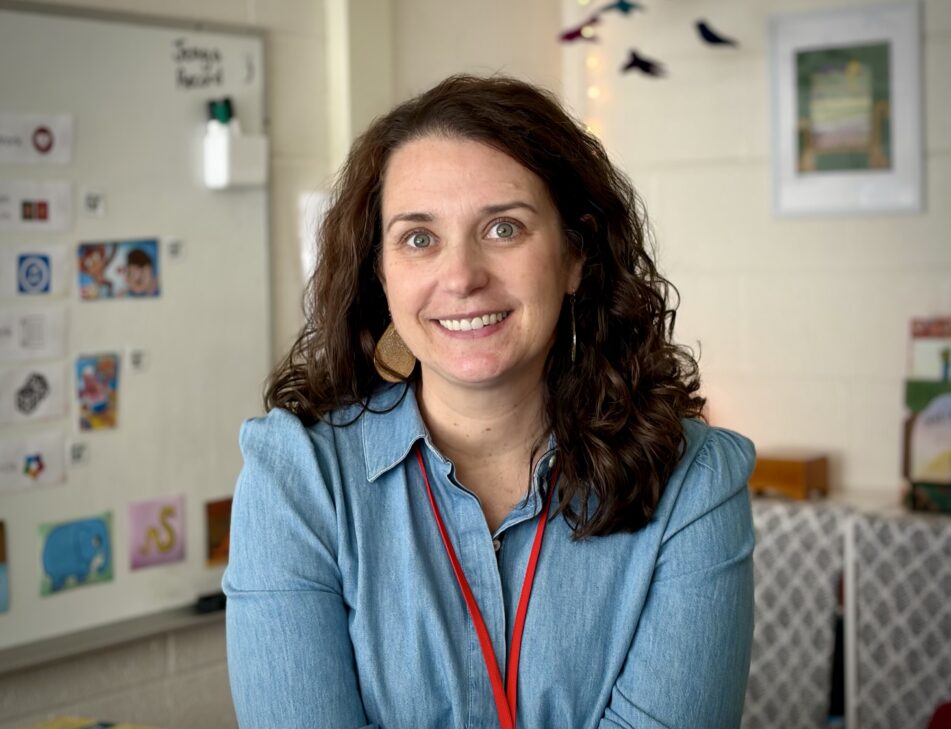
Allen Elementary School Social Worker Megan Smulders grew up in Columbus, Ohio, attended Columbus School for Girls, and earned a Bachelor of Science in Communications from Ohio University before completing her Master of Social Work at the University of Michigan.
She and her husband, Wilfred, met while living in Atlanta, Georgia, where both worked at the Georgia Institute of Technology. Wilfred was completing a postdoctoral fellowship at Georgia Tech, and Megan worked in event planning at the university. After spending the early years of their relationship in Atlanta, the couple moved to Wilfred’s hometown in the Netherlands, where they lived for several years before returning to the United States.
When her husband’s work eventually brought the family to Michigan, Smulders earned her Master of Social Work from the University of Michigan. She began her social work career in medical settings, primarily working with older adults. Shortly after, the couple started their family, which led her to pause her professional career for 11 years while she stayed home with their children, Lucia, Rowan, and Vivian, who are now eighth graders at Tappan Middle School.
When their children were in fifth grade at Burns Park Elementary, a part-time social work position became available there. Megan welcomed the opportunity to work in the school community she loved. She spent two years in a split position between Burns Park and Haisley Elementary before transferring to Allen Elementary two years ago.
What does a typical day look like for you as an elementary school social worker?
For the most part, my days are spent working one-on-one or in small groups with students to strengthen socio-emotional skills. Supporting children as they work through escalated feelings is another big part of my role. In between student sessions, I connect students and their families to resources within AAPS and the broader community, meet with general education/special education team members and families, evaluate children for special education services, and work to understand and support the behavioral needs of our students.
How do you help young children who might not have the words to express what they’re feeling?
That’s a great question, and I think it’s different for every child. Children experiencing heightened emotions benefit from an environment with low sensory input, so I do my best to maintain an office space that is just that. When I see a child working hard to identify their emotions, I have to remind myself to limit my language and give the child the gift of pause. Time and a quiet space can help children gain more clarity. I love using fidgets, playdough, kinetic sand, and art to help with the initial discomfort of sitting through silence. I incorporate Zone of Regulation and Mood Meter visuals in nearly every interaction I have with my students; sometimes seeing the emotion on a visual can help children identify their feelings. And, as with many hard things in life, practice makes the process easier.
What’s the most rewarding part of your job?
Supporting Allen’s morning arrival routine is the highlight of my day. I love seeing the children first thing in the morning: moments of captured hope, resilience, friendship, and anticipation as the children approach the school sidewalk. I’m reminded of how meaningful school is for most of our children and of the great responsibility we—the adults—have to cultivate a safe, loving day for every child who steps foot on campus.
What’s the most challenging part?
Oh gosh, where to begin? I could keep it simple and say, “There’s never enough time in the day.” But in all seriousness, at the macro level, families in our community are struggling to meet their basic needs. When a child’s physiological needs, the very bottom of the pyramid, are not fulfilled, it’s pretty hard to expect academic engagement and growth. Thinking about my day-to-day work, supporting children with recurring behaviors can be tough, too. Seeing a child struggle without a clear understanding or solutions is disheartening, especially when working within the framework of “behavior is communication.” I’m fortunate to work with a strong team at Allen, but even given that, we don’t always have the answers.
If you weren’t a school social worker, what do you think you’d be doing?
Oh, for sure, I’d be rocking every baby handed to me. I’d change diapers, swaddle, and rock the babies all night long.
If you could choose to do anything for a day, what would you choose?
I would spend the whole day, sunrise to sunset, with my mom. Just the two of us, in our pajamas, watching television under a warm blanket, drinking tea, with our dogs at our sides.
What’s most exciting about your professional life?
I’m in my third full year working as a school social worker and my second year at Allen. I’m starting to
get the hang of things and am feeling more confident in my role. I’ve learned that when I need help, there is a whole team of colleagues at Allen (and beyond in the district) who are always willing to advocate and mentor.
I’ve found confidence in understanding special education policies/procedures, and with that, I’ve gained more space to invest in my relationships with colleagues, students, and families. My own children are approaching high school, enjoying their independence, and for me, motherhood has been beautiful and intense with all three children the same age. I’m so grateful for my work and the purpose and identity it brings to my life.
How do you spend your summers?
I spend most summer days with family and friends at the Racquet Club of Ann Arbor—my favorite time of year. We visit my husband’s family in the Netherlands, squeeze in some trips up north with friends, lots of walks
with my dog Jazzy, and of course, making sure Lucia, Rowan, and Vivian get to their sports/activities
and are well fed and loved.,
Be the first to comment