


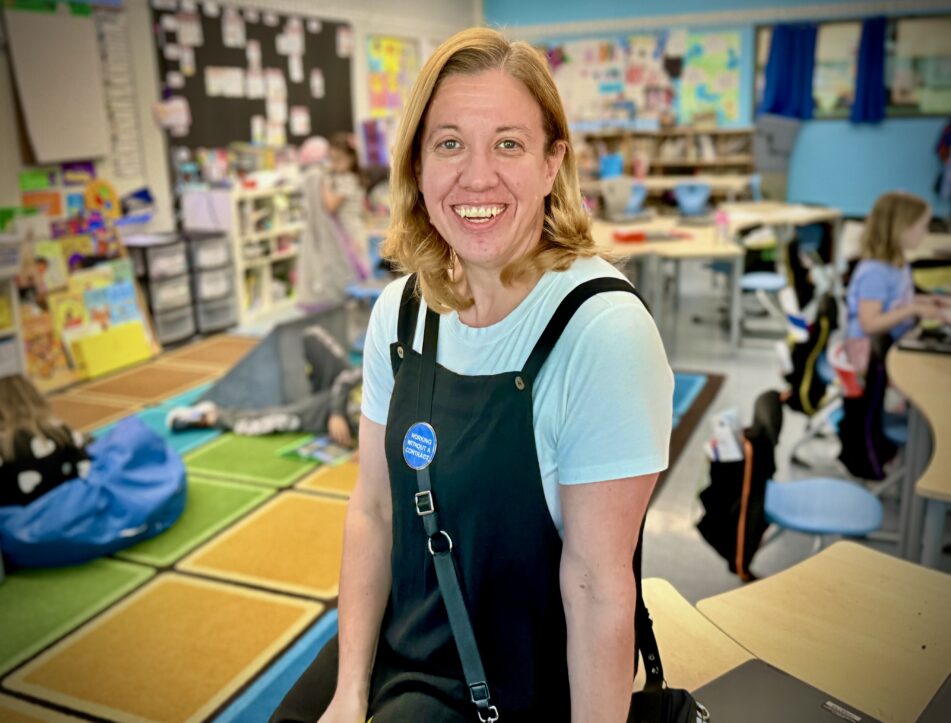
Bryant second grade teacher Julianne Cooper was born and raised in the small downriver community of River Rouge. She has been married to her husband, Jeff, for 17 years, and they live in Pinckney with their two children, Julius (4th grade) and Julie (2nd grade), who attend Bryant/Pattengill.
Cooper’s early career was in contract procurement and project management within the commercial construction sector, followed by work supporting members of the National Guard across the United States. After becoming a mother, her professional goals shifted, leading her to tutor and teach multilingual students learning English. She entered the teaching profession through an alternate route to certification and joined Ann Arbor Public Schools first as a substitute teacher, then as a long-term substitute for Young 5s at Allen during the return to hybrid learning. She later joined Bryant as a second-grade teacher and transitioned to first grade to deepen her impact on students’ literacy development.
Most recently, she earned a Master of Arts in Teaching English to Speakers of Other Languages from Western Michigan University as part of the grant-funded AAPS Grow Your Own Cohort program. In her free time, she enjoys crocheting amigurumi, gaming with her children, and traveling when possible.
Why did you choose to work for Ann Arbor Public Schools, and have there been any surprises?
I chose to work for AAPS because of the focus that was placed on equity in education for all students and because, in 2020, I felt that AAPS was making responsible decisions to protect student and teacher health and well-being amidst a global pandemic. I wanted my own children to attend school here, in a culturally diverse community, and to learn from educators who prided themselves on celebrating student differences.
It is surprising how things have changed within a time span of five years. In my opinion, student-facing staff were appreciated, and we could see it and feel it when I started with AAPS. I remember feeling relevant and appreciated by the Superintendent and BOE; some even visited my room and building each year. I still feel appreciation from my principal and my students’ families. However, I am really surprised at the actions and intent to increase class sizes and cut our planning time. Ultimately, these proposals both equal cutting more teachers. That is the reality of what has changed now. I am asked to teach more children in the same classroom space, but with less. Less teaching assistants, less support staff, uncovered lunches, no hand sanitizer, less supplies. While the cost of living has increased significantly during my tenure, my salary has not kept up, and benefits are incredibly more expensive. If you visited my classroom on any given day, I think it would be obvious how short-sighted and detrimental to student and teacher growth and well-being these suggestions are.
What do you like about working at Bryant?
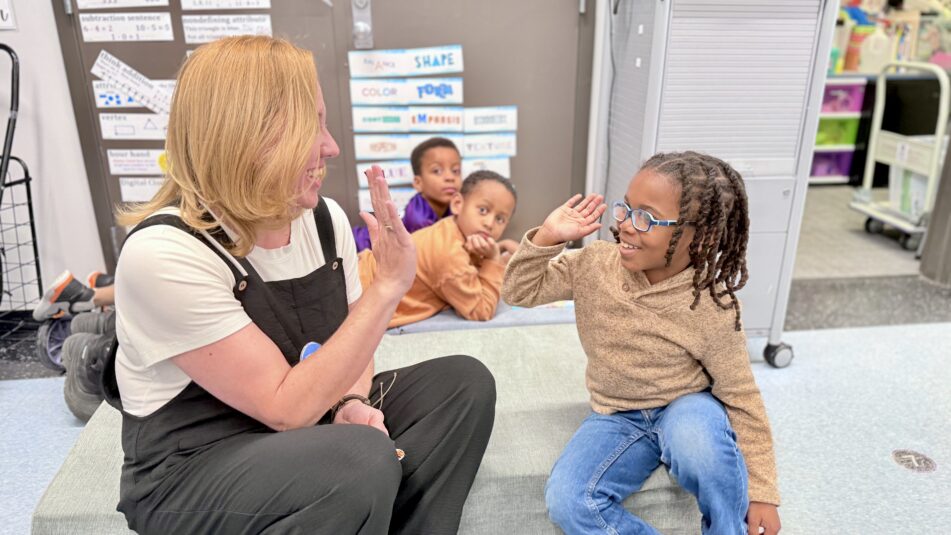
I love the energy we have as a preschool to second-grade building. Our students have a unique experience at Bryant. There’s a tangible shared belief with our team centered on the dignity and growth of every child, and that shows up in how we as staff collaborate, problem-solve, and support one another as an elementary team. I am surrounded by exceptional colleagues who are the best human beings and exceptionally good at what they do every day. I appreciate that Bryant prioritizes both academic learning and social-emotional development, and simultaneously realizes the role we play within the larger Bryant and AAPS community. Being led by Principal Jamar Humphrey creates an environment where I feel trusted to meet my students’ needs, encouraged to reflect on my practice, and supported in doing the kind of teaching that helps every child feel seen and capable.
Why did you pursue a career in teaching?
I pursued a career in teaching to better align my professional aspirations with my life as a mother. Becoming a mother changed my world and my perspective on who impacts our children. I wanted to have a career that allowed me to have a schedule similar to that of my children so I could be present.
Why first grade?
I feel very strongly about the Science of Reading and vertical alignment of curriculum. After being a second-grade teacher, when my principal approached me with the grade level change, it was an easy but thoughtful decision to say yes. Having the unique perspective from the 2nd grade above, I recognized opportunities to be more impactful and the ways to frame my practice around building stronger foundational literacy and math skills for our primary students.
Describe an average workday.
My kids and I commute in from Pinckney, and our first stop is the Arbor Oaks bus stop for Pattengill. My kids and I get to chat with other Bry/Pat families before heading to Bryant to start the day. I am working this year with the most incredible TA.
I begin with greeting students in the hallway and doing check-ins as everyone arrives, then on to supporting students 1:1 or in a small group for some morning work or targeted instruction time. Our morning meeting sets the tone for the day, including greeting each other and reciting affirmations and our essential agreements. We follow it with Arts & Letters and recess. Then comes phonics and differentiated literacy instruction, or a special. I usually bring lunch from home, or you can find me at the copy machine before picking students up for Mindfulness and SEL. After resting and resetting for the afternoon, the class is on to another special or math before snack and recess. Our day finishes with science, social studies, or health lessons, then a closing circle.
The last thing we do is give “sparkle” to someone who has made the day better or who you think did a great job at something.
I head out to the driveline and then to wait for the bus to arrive from Pattengill, while my daughter gets to play with friends on the playground. I head in to feed our tadpoles and snails, and maybe a quick catch-up with a colleague before closing up the classroom for the night. Then we commute home, head to swim practice, or stop in town to visit my mother-in-law.
What are your best tips for classroom management?
Relationships come first, and everything runs through connection. To build a successful classroom, you have to genuinely learn about student identities and reflect it back in your teaching. Consistency is everything. Expectations cannot be assumed; they must be modeled, taught, and revisited throughout the entire year. Teacher language is paramount. Learn how to be consistent, firm, respectful, and intentional with every interaction, every day. Finally, be joyful with your students and have fun while teaching and learning together. There is a magic that only exists in childhood, allow the students to bring that magic into their space and embrace it.
What’s the happiest part of your day?
Our morning meeting routine is probably the happiest part of my work day, partially because we greet each other to the Golden Girls Theme Song, but especially when a student (our weekly cheerleader) takes the lead and has their peers recite the daily affirmations of “I am brave, I am kind, I am strong, I am smart, I can do anything”. Watching each student share the role from week to week and become a leader for their classmates is powerful and empowering. Because it is student-led, I get to observe some students smile for the first time that morning, or some encourage others to participate, or some focus intently on just the comfort of routine. It is such a special part of our day and my class that I gift each group of students with a keychain with these statements to carry it with them into their next grade.
What do you want most for your students?
What I want most is simple—but it carries a lot of weight. I want every child I teach and interact with to truly know, “I am capable, and I belong here.” I know that once a child feels that, everything else becomes possible.
I want them to read—truly read. Not just decode words, but make meaning, see themselves in stories, and understand others through them. Reading is access. It’s power. It’s independence. And I take seriously my responsibility that if a child leaves my classroom without that foundation, doors start to close for them. That’s not acceptable to me. I believe reading is a fundamental human right and a key component to liberty. I recognize that if I do my job successfully, each student graduates from my classroom stronger and with a solid foundation of skills that the next teacher and their families can build upon.
In practical terms, that means I’m constantly adjusting—how I use data, how I build language, how I choose texts. It means I don’t assume anything about my students—I listen, learn, and seek to find the right ways to help every one of them grow every day.
How do you prevent burnout?
Time with my own children. Laughter and camaraderie at work.
What’s the cutest thing one of your students has said lately?
“My brain grew today.”
“We’ve got to save him!” (Seeing and thinking that one of the tadpoles was stuck.)
Favorite podcasts, websites, apps:
Melissa and Lori Love Literacy, The Right to Read Initiative, The Science of Reading: The Podcast, Pod Save America, the book “Help for Billy: Beyond Consequences Approach for Helping Challenging Children in the Classroom”, and the app Moshi Kids.
Was there a teacher who had a particularly strong influence on your career? If so, what did you learn?
There is more than one to note. My mentor teacher, Jessica Posey, and building lead teacher Kim Micou-Davis have been more influential than I think they will ever know. They supported me through the first years as I built my confidence and practice. I am honored and grateful for their time and willingness to lead and guide. And my colleagues Maggi Rohde, Conor Callam, Alissa Amell-Postler, Amy Satchwell, and Katherine Brewer. Their advice and friendship shaped my perspectives and practice in regard to building relationships with students and families, managing conflicts, and collaborating as a team. They all shine brightly as exemplary teachers who have impacted and inspired me to be authentically myself.
How is teaching different from the way you imagined it would be?
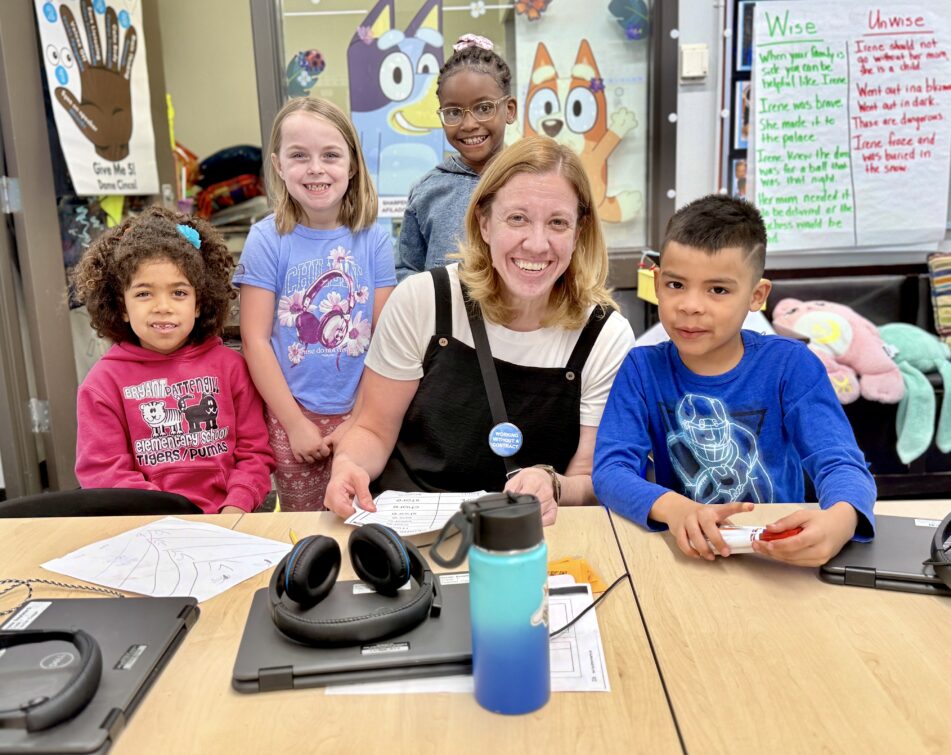
I find it much more fulfilling than I thought it would be. Personally, teaching has so many opportunities for personal growth that align with becoming better in your practice, and while I recognized the overlap, I don’t think I could have imagined all the experiences, incredible people, and challenges that continue to shape me as both a teacher, a mother, and a human being.
How has the job changed since your first year?
I am doing my job with less support. There are significantly fewer student-facing staff in our building than when I started. We no longer have a behavioral interventionist; we share most of our support staff (OT, Speech, and many special teachers) with other buildings. Many Teaching Assistants are split part-time between classrooms and students. When I started, we had more full-time staff and could effectively and efficiently support various student needs and development. In my first years, we were like a fully rostered sports team where each member had a position and did it well. Now our team constantly has to figure out how to make it through the day with less. Sometimes it feels like a team constantly trying desperately to win while missing key players. I am also making less due to inflation and the AAPS salary schedule not following suit, and higher costs of healthcare plans.
How do you spend your summers?
By the pool, in the sunshine, near a campfire, and enjoying Michigan’s Great Lakes.
What’s most exciting in your personal life right now?
My daughter is getting prepared to transition to Pattengill for third grade, which is a milestone, and will be the first time in a long time that I won’t have one of my children at Bryant.
Be the first to comment