

Photos by Jo Mathis/AAPS District News
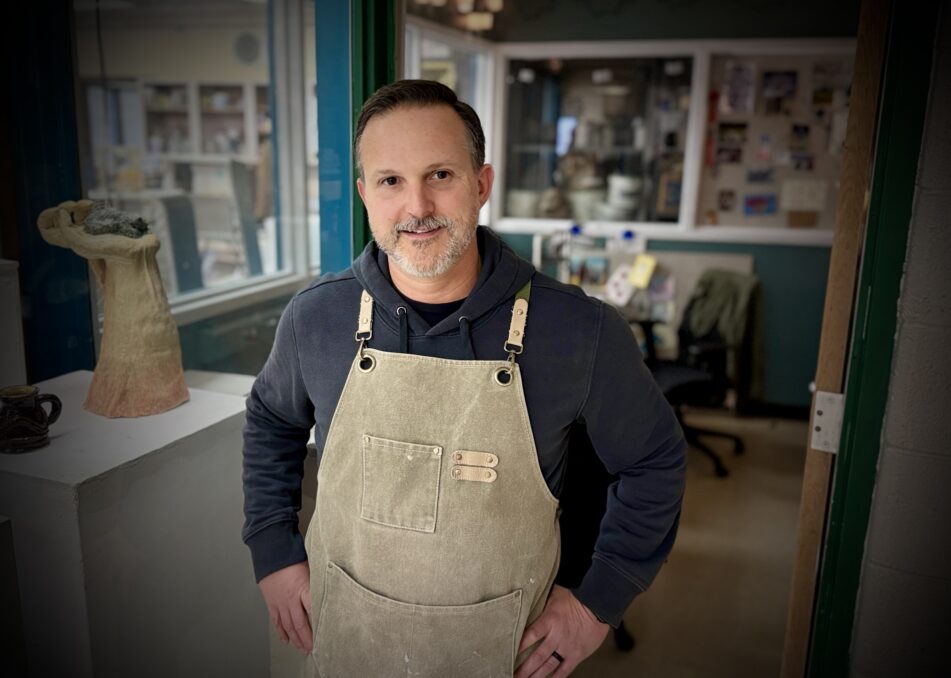
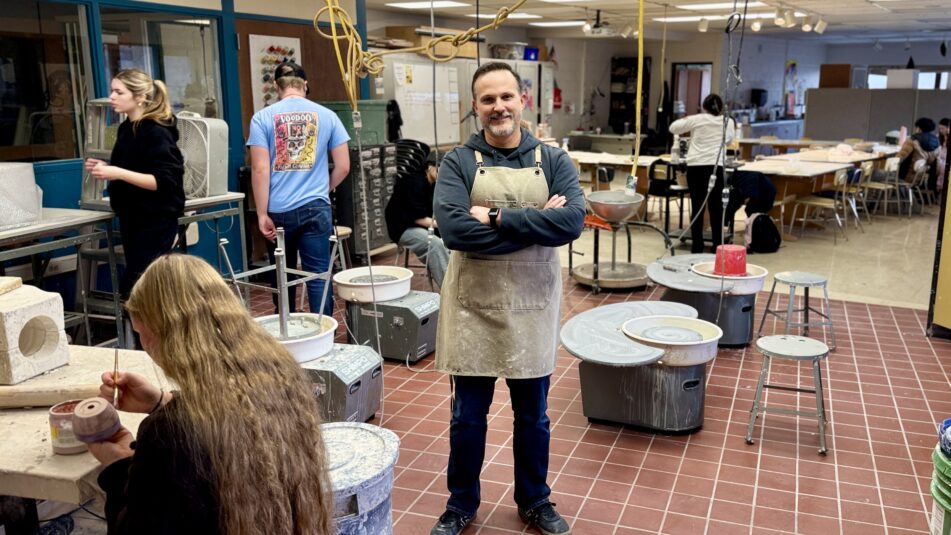
Jonathan Smigell grew up in Plymouth, Michigan. After graduating from Canton High School, he attended Wayne State University, where he earned a BFA in Painting and Photography. He later received his art education certification along with an MA in Ceramics from Eastern Michigan University. Smigell began teaching at Huron High School in 2003. He lives in Plymouth with his wife and their two teenage sons.
Huron ELA/humanities teacher Aimee Grant calls him the “unsung hero of the art department.”
“He is patient, kind, funny, and the best ceramicist in the district,” she says. “He is a school leader in both his ceramic classes and the expertise he brings to the Humanities team. He has the best art studio vibe—open-minded, collaborative, and just plain fun. He is a master at small talk and uses it to build strong relationships with his students, who adore him.”
Grant noted that Smigell brings Humanities students into the ceramics studio to move beyond a lecture about ancient Greek vessels and demonstrates throwing a pot on the potter’s wheel to show students the techniques they’re studying. He also shows students how to create their own Greek columns, soap carvings similar to Michelangelo’s, and watercolors reminiscent of Monet’s.
“He makes learning come alive for students,” she says, “and Huron is lucky to have his service for over 20 years.”
What led you to pursue a career in art education?
Art was a big part of my life growing up because my mom is an artist and a retired public high school art teacher. She was always working on some kind of painting, drawing, or creative project, which made creativity a constant presence in our home. Because of this, I knew from an early age that I wanted to pursue a career in visual art. After earning my BFA, I immediately returned to school to earn my degree in art education.
How do you encourage creativity and self-expression in your students? A big part of what I do is encourage students not to be afraid of making mistakes. I truly believe we learn the most when we’re given the freedom to take chances and figure things out, even when something doesn’t work the first time, or even the tenth. I try to help students see “mistakes” as learning opportunities rather than failures.
Just as important, though, is creating a classroom environment that feels safe, respectful, and easygoing. I believe students need to feel accepted for who they are in order to have the courage to step outside their comfort zones and really dive into self-expression. Because of that, I make it a priority to take the time to genuinely get to know my students.
I also believe that having fun and not taking things too seriously plays a big role in encouraging creativity. Keeping the vibe light helps students relax and feel more comfortable taking risks. There’s a lot of laughter in my day, whether I’m teaching Ceramics and Sculpture, Humanities, or collaborating with colleagues, and I think that positive energy really supports creative growth.
Which art mediums or techniques do you most enjoy teaching, and why?
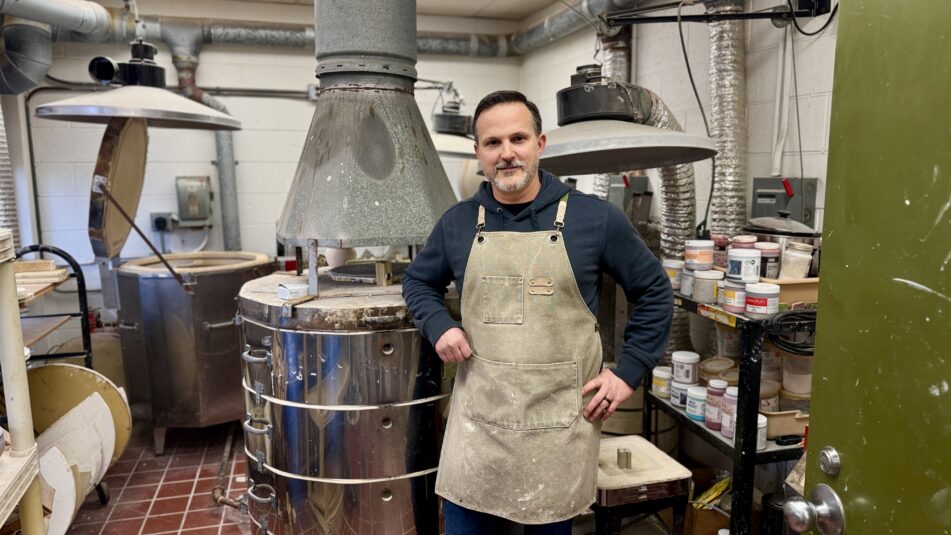
Over the past 23 years at Huron, I’ve had the opportunity to teach drawing, painting, printmaking, and jewelry/metalsmithing, and I’ve truly enjoyed working with all of those mediums. That said, I have an MA in ceramics, and teaching and working with clay is where my heart really lies. There’s something incredibly engaging and rewarding about ceramics, and I honestly believe the potter’s wheel is one of the best things in life.
What role do you think the arts play in a student’s overall education?
I believe the arts are more important than ever in a student’s overall education, especially as AI and technology become a larger part of daily life. The arts support human qualities that can’t be recreated by machines. Through making and responding to art, students learn to observe life more closely, interpret meaning, and connect with their own life experiences as well as others.
Art gives students space to explore identity, take risks, and express ideas that don’t always have clear answers. I believe our world often prioritizes efficiency and productivity; the arts remind students of the value of reflection, imagination, and personal cultural expression.
You teach both Visual Art and Humanities/Art History at Huron. What is it like teaching in two different departments?
I absolutely love being part of both departments. It’s such a privilege to work alongside people who are not only amazing teachers but also genuinely wonderful humans. I have so much fun collaborating with Kristin Kubacki, Lyndsey Vockel, Ann Townsend-Zhu, and Abby Loughrey in the Art department and Aimee Grant and Jeff DeMoss in Humanities. I also have to mention my wife, Sara Smigell, who teaches Health and PE (mostly yoga) at Huron, and inspires me every day.
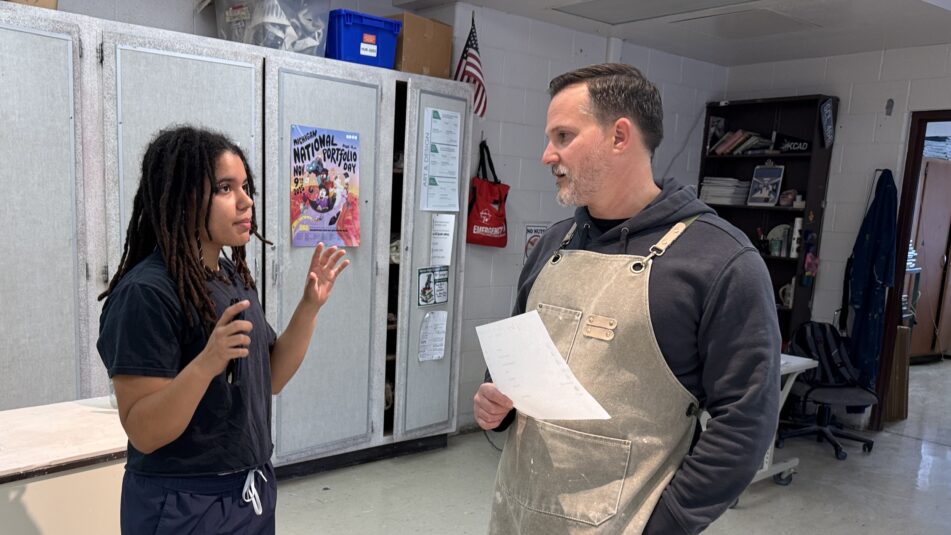
Being around colleagues who are so creative, supportive, and passionate pushes me to grow as a teacher and as a person. I am incredibly grateful to learn from them, share ideas, and be part of two departments that are so truly outstanding.
Outside of teaching, what’s one personal creative pursuit or interest you have?
I’m kind of obsessed with food and cooking. I spend a lot of my free time in the kitchen experimenting and preparing meals, and it’s honestly one of my favorite ways to be creative. I also love collecting cookbooks, listening to food podcasts, reading cooking magazines and chef biographies, and watching cooking shows on TV. Food is a huge source of inspiration for me, and cooking feels like another form of art and self-expression.
Be the first to comment