

A year after her all-female mission aboard Blue Origin’s New Shepard, the Slauson alum returns to a cheering crowd of eighth graders, sharing her path and fielding questions
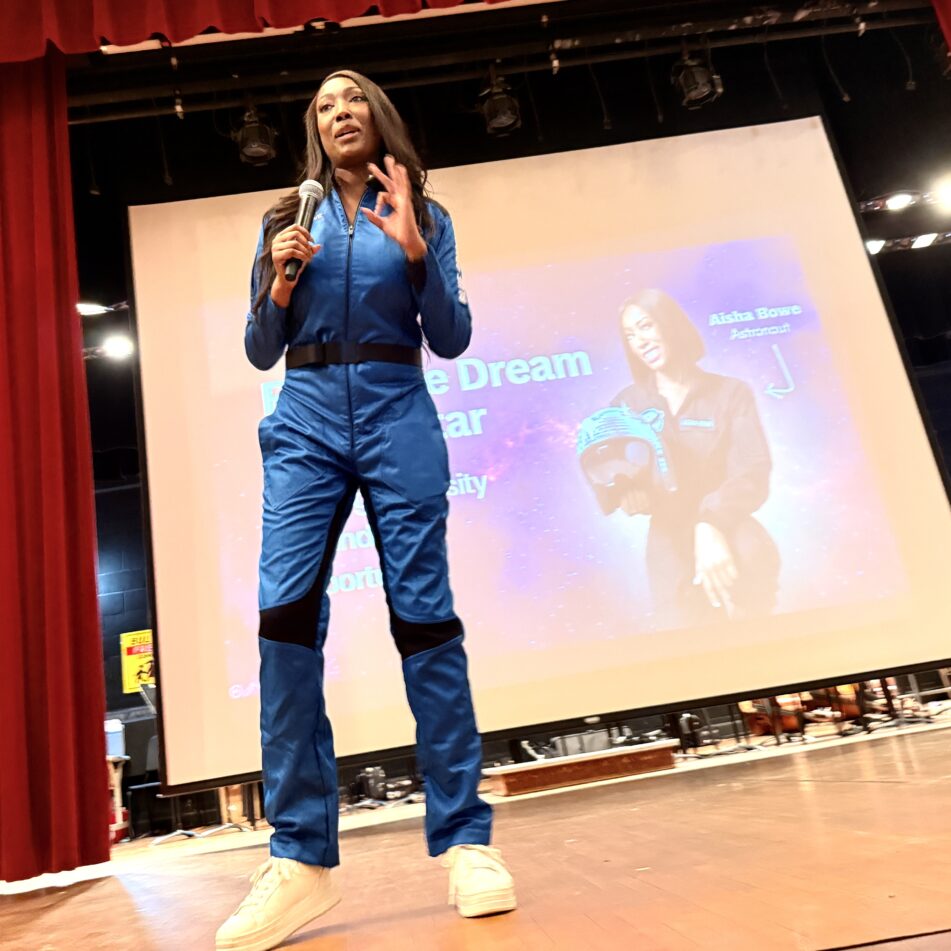
When rocket scientist/entrepreneur Aisha Bowe walked into the auditorium at Slauson Middle School to enthusiastic cheers on Thursday, she didn’t stand behind a podium for long. Instead, she moved through the room, asking questions, tossing out ideas, and inviting students into her story.
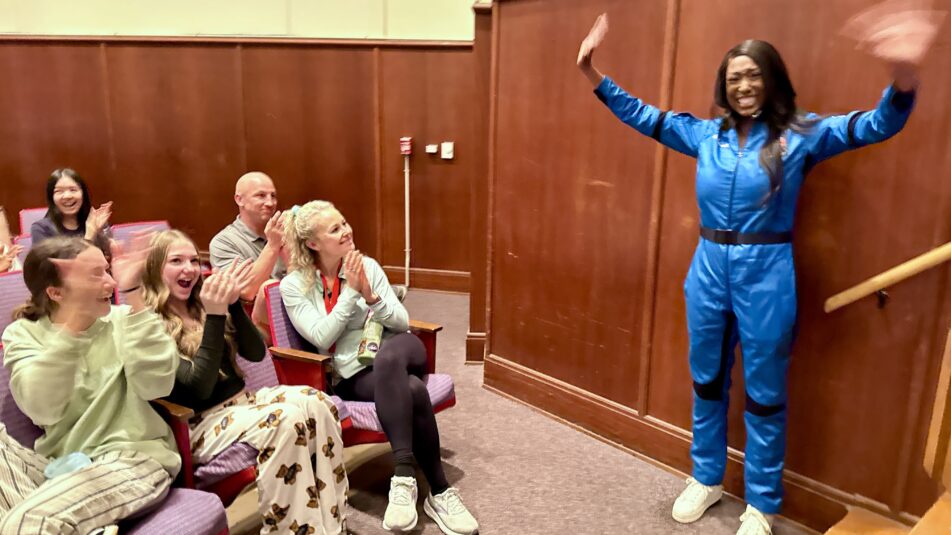
“I’ve never really been good with standing behind a lecture,” Bowe told the crowd of enthusiastic eighth graders gathered at the assembly. “I like to walk around. I like to interact.”
Bowe, an aerospace engineer, entrepreneur, and former NASA scientist, returned to her alma mater not just to talk about space—but to “keep it real,” as she put it. She said that as a student, she didn’t always have a clear direction. “When I was younger, I really had no idea what it was that I wanted to do,” she said. “I didn’t see anybody who really looked like me doing the things I thought about… so I was kind of like, what’s the point?”
That changed when she found her path through Washtenaw Community College and the University of Michigan and beyond.
“I discovered that it was possible—not only for me to dream—but for me to become whatever it was I thought I could become,” said Bowe, who began her three years at Slauson as a sixth grader in 1997. “I didn’t lean into the odds. I leaned into the belief that the impossible was something perfectly possible for me to do.”
That belief ultimately carried her to space.
On April 14, 2025, Bowe flew aboard the all-female Blue Origin N-31 rocket, conducting experiments on plant growth and collecting biometric data. She described the experience in vivid detail—moments of weightlessness, the intensity of launch, and the overwhelming view of Earth from above.
“You don’t have time to be scared,” she explained. “You have to focus.”
Later, when she finally looked out the window, the moment stayed with her.
“You can feel the energy of Earth,” she said. “It is so completely overwhelming that you realize this experience is a miracle.”
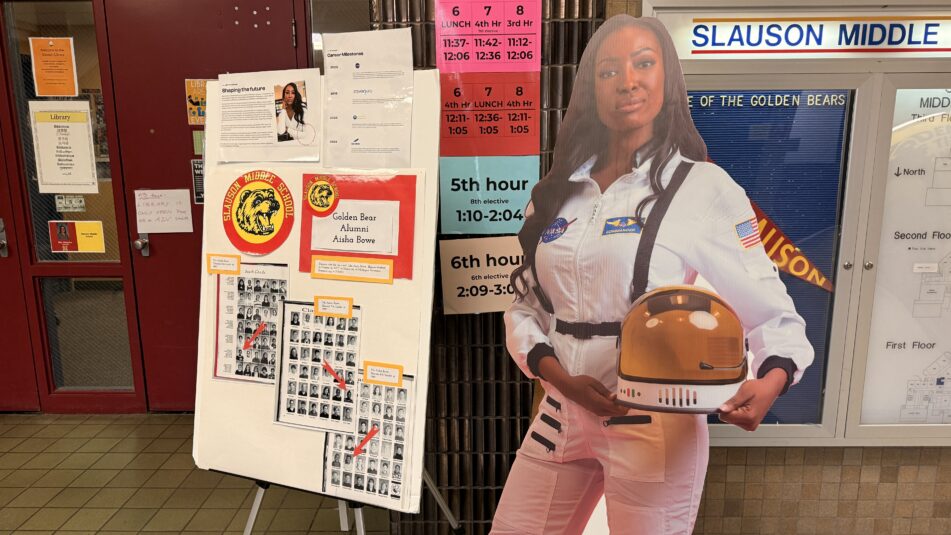
Throughout the talk, Bowe connected her journey to the students’ daily work in school. She reminded them that the math and science they sometimes question have real-world impact.
“When I got to NASA, I realized that all that math… could actually save someone’s life,” she said. “Don’t think about it as just a problem. It will translate to something real and meaningful.”
She also brought the conversation to the present, asking students about the Artemis program, NASA’s current mission. Bowe emphasized that space exploration isn’t just for astronauts.
“The future of humanity depends on everyone,” she said. “Some of those people are doctors, lawyers, therapists… there’s room for everybody in every dream—even the biggest projects.”
That message resonated with staff who remembered her as a student.
“I had Aisha Bowe in seventh grade, and she was a quiet, friendly student,” said English teacher Maria Murphy. “She was just a regular kid… and now she’s an aerospace engineer. I hope students see how far their education can take them.”
Principal Brandon Szwelkowski said the visit had been months in the making, made possible through community connections. “We’ve been working on this for six months to bring her back,” he said.
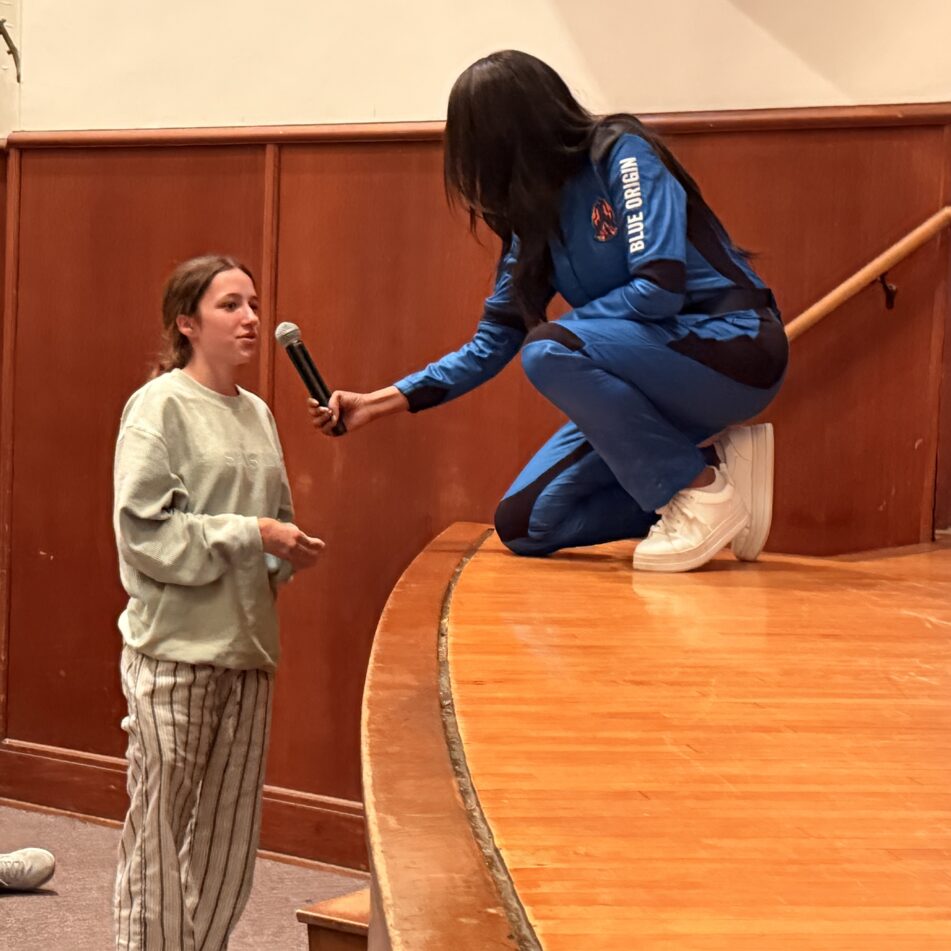
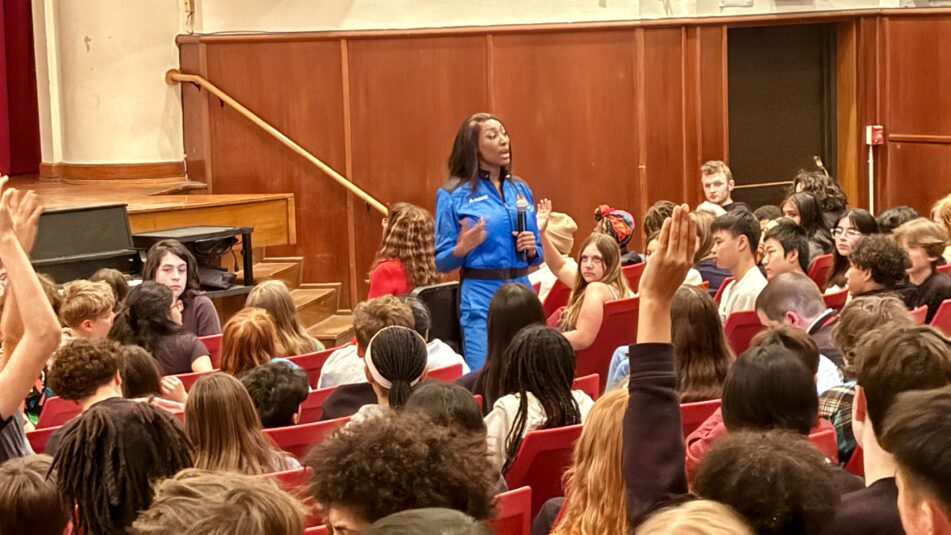
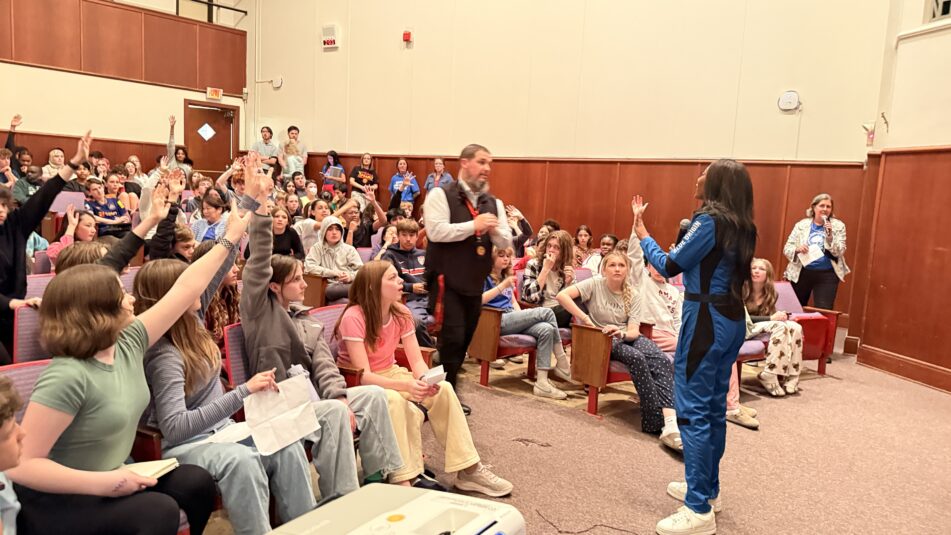
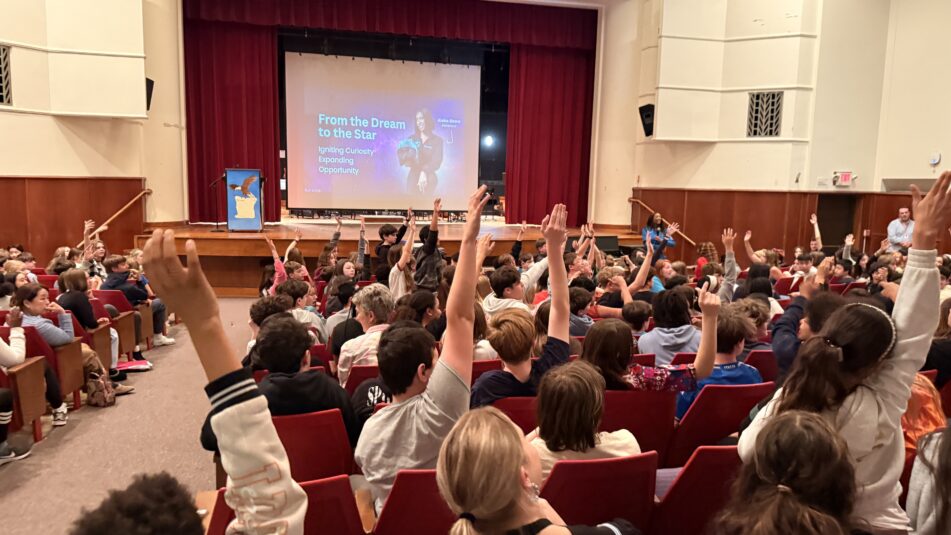
Students didn’t just listen—they engaged. They asked about her experience in middle school, and about what it feels like to float in space. Bowe answered candidly, even sharing her own fears while describing the vast blackness of space. But she also spoke about growth, confidence, and choosing to move forward anyway.
Students asked about a fear, of dying, about what it was like working with Katy Perry (the publicity helped, she said), and about what had surprised her most. She decided she wanted to be fully present for whatever came. “I used to be afraid,” she said. “I said, you know what — I need to step into this experience and just enjoy the moment for what it was.”
She spoke, too, about representation, about the deliberate care she took with her appearance for the flight—wanting young girls to know that femininity and engineering excellence were not mutually exclusive. “I did not want to be in an eighth-grade textbook with my hair not right,” she said. “There is a perception that women in engineering are not feminine. I wanted to represent who I am in entirety.”
For Bowe, the most meaningful part of her work isn’t the flight itself—it’s moments like this. “If I can come back here… and you see that I did something that once felt impossible,” she said, “then I’ve done my job.”
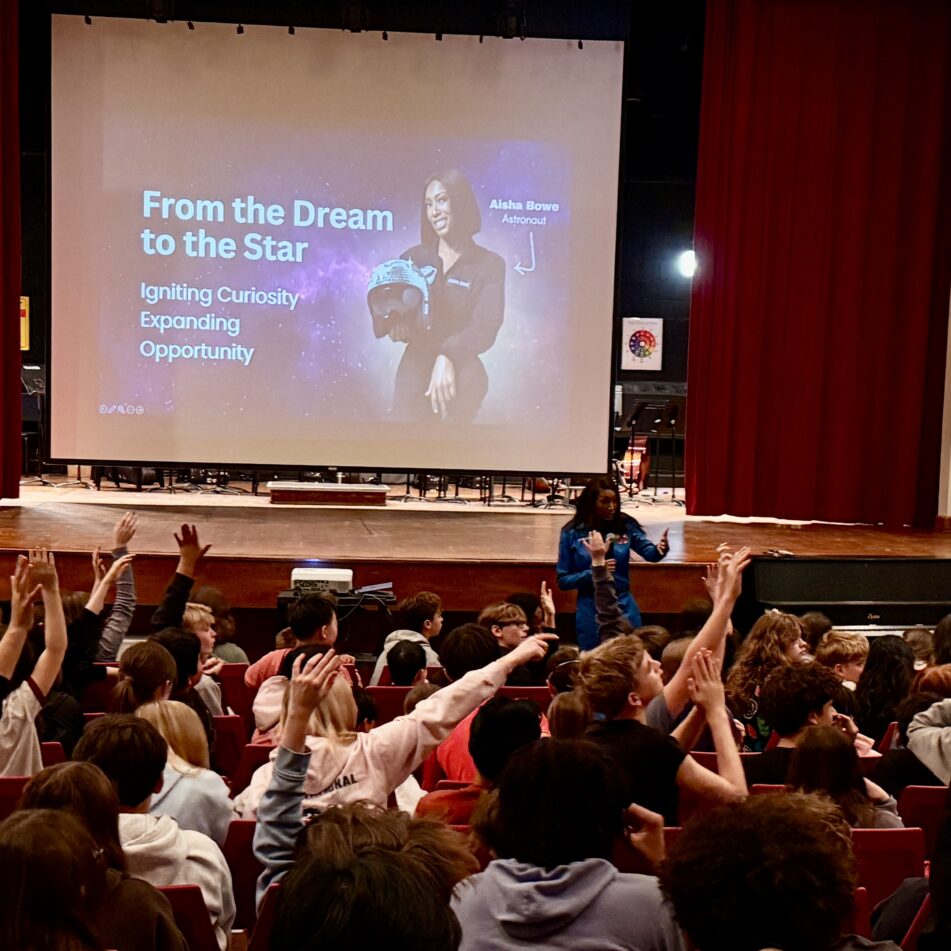
Szwelkowski said he hoped students would leave with an understanding of the routes available to them. “Coming through Ann Arbor Public Schools, then going through WCC — there are multiple paths to greatness,” he said. “We hope our kids hear that today.”
Be the first to comment