

Democracy in Dialogue is sponsored by the Smithsonian Institution, through the University of Michigan Museum of Art
Eight Community High School students are discovering that democracy is more than just casting a vote. It’s about listening, sharing, and building connections across thousands of miles.
This fall, students enrolled in Democracy in Dialogue, a University of Michigan Community Resource course taught in conjunction with the University of Michigan Museum of Art (UMMA). Sponsored by the Smithsonian Institution, the program pairs Ann Arbor students with peers at Girls Inc., an organization in Oakland, California, creating an unusual laboratory for cross-country civic engagement.
Amy Frontier, an English teacher at Pioneer High School, participated in a prior cohort that introduced the program to AAPS.
Finding Common Ground Through Objects and Stories
The heart of the course lies in an exchange that goes deeper than typical pen-pal relationships. Students from both communities share stories about the places, objects, and people that define their lives, learning to craft narratives that resonate with audiences who’ve never walked their streets or experienced their daily realities.
“We share stories about our community, and they share theirs,” says Grace VanderVliet, Curator for Museum Teaching and Learning at UMMA. “We’ve exchanged packages and are diving into how to tell compelling stories about objects, places, and people—to an unfamiliar audience.”
She noted that the Smithsonian Institution made the project possible by offering robust training and curricular resources, connecting UMMA with Girls Inc., and holding regular support meetings for all the cultural organizations in the cohort.
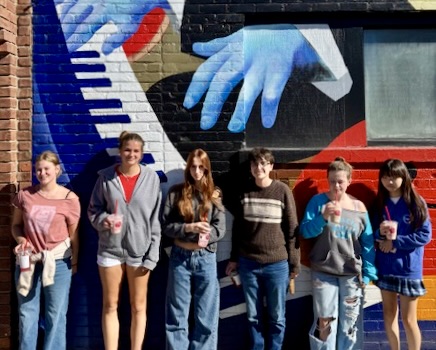
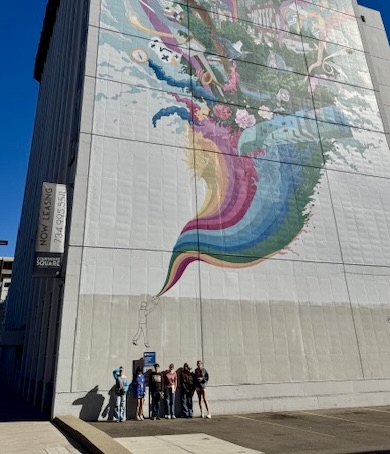
“Because the class is taught by me and my colleague Kafi Laramore-Josey, and we both work at the University of Michigan Museum of Art, we’ve focused on how art can be a powerful force that unites people,” she says. “We walked through downtown Ann Arbor to take in the many murals, and we shared photos with our partners at Girls Inc. They, in turn, shared murals in their neighborhood. We wondered together if the animals in their mural were perhaps panthers, a reference to Oakland being the home of the Black Panthers. Because we were paying attention to our surroundings and looking with new eyes, these were the types of questions we jointly investigated.”
The students are now moving into creating final projects, refining one of their exchanges into a creative format, such as a collage, an article, or a film. The finished work will tell a compelling story about how an object, place, or person in Ann Arbor has been meaningful to them personally and also carries universal significance, said VanderVliet.
Those projects will be shared with their partners at Girls Inc. and with the Smithsonian Institution. Each student will receive a certificate of participation from the Smithsonian Institution.
Finding Her Own Path Through the Past
Freshman Erin Kawata came to the course seeking a chance to explore local history close to home. Researching the closure of Downtown Home & Garden, a business just one block from where she used to live, Erin transformed personal sadness into something hopeful. Through interviews with a local archivist, a real estate broker, and others, she began wrestling with bigger questions about how small shops and e-commerce giants might coexist in today’s rapidly changing landscape.
What made the experience truly memorable, though, were the unexpected connections Erin made while collaborating with peers from Girls Inc., exchanging stories across the country.
Erin said she would absolutely encourage others to take the course.
“This course is like a ‘choose your own adventure, ’ and it allows you to take charge of what you want to do and how you deliver it,” she said.
Senior Josie Simpson said she took this class because I was interested in learning more about the field of museum studies. I think the biggest thing I’ve learned from it is that all the things around me—whether they’re objects, places, or people—are interesting in some way, if I take the time to find out their stories.
Reading the Walls: A Mural Study
One recent project took the students on a walking tour of Ann Arbor’s murals, examining not just the artwork itself but the meanings embedded in public art.
“We took a walking tour of Ann Arbor murals, explored their meaning, and compared them with murals in Oakland neighborhoods,” VanderVliet explains. The mural project exemplifies the course’s approach: using tangible, visual culture as a gateway to understanding how communities express themselves and engage in civic dialogue.
The Smithsonian-sponsored course reframes democratic participation as something that happens in everyday exchanges, not just at the ballot box. VanderVliet notes that the eight students will complete final projects this month, synthesizing what they’ve learned about storytelling, community identity, and cross-cultural communication.
She said she recently gave students a pin that says “Democracy is not a spectator sport.”
“They had a great discussion about what it means for teen voices to be part of democracy, even before they can vote. Many are interested in working the polls—eligible at age 16—and they discussed how they can stay informed and make an impact in the community right now.
UMMA has had two projects, Vote at UMMA and Hey, We Need to Talk, that focus on University students and adults, promoting dialogue and democracy. This DiDVE course is an extension of those specifically to honor and listen to teen voices.
Be the first to comment