

The recognition honors not only Sarah VanLoo’s dedication but also the creativity of her students and their connection to future STEM careers.
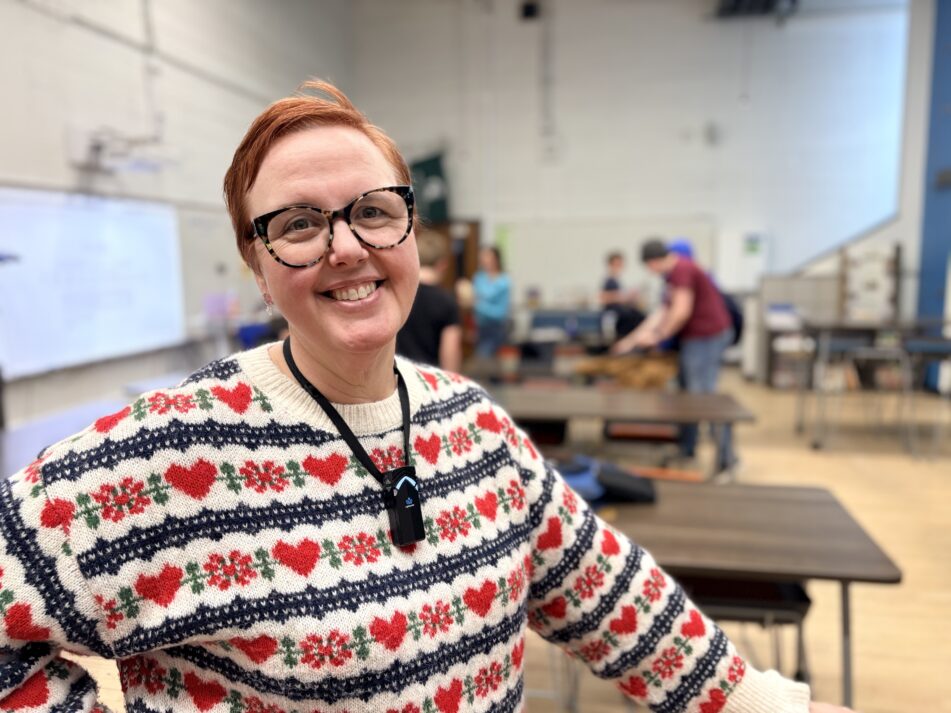
Students at A2 STEAM Middle School aren’t just building, coding, and testing robots—they’re developing teamwork, problem-solving skills, and a strong sense of inclusion.
That commitment to outreach and making space for every student recently earned educator Sarah VanLoo a prestigious international honor. She was selected for the 2026 Inspire the Future: FIRST Recognition Program Educator Cohort, one of only 15 educators chosen from more than 400 nominees worldwide. The cohort includes teachers from Canada, Mexico, Morocco, Saudi Arabia, Turkey, and the United States who are creating lasting impact by helping students see themselves in STEM through robotics.
VanLoo coaches A2 STEAM’s middle school teams in the FIRST Tech Challenge (FTC), where students design, build, and program robots for themed competitions while embracing FIRST’s core values of collaboration, inclusion, and knowledge-sharing.
She described herself as both surprised and humbled by the recognition, which came after a colleague’s nomination and her essay on inclusion and outreach.
“Personally, I am honored and humbled to have been selected,” VanLoo said. “Our robotics teams at STEAM are relatively new, and we’re in a growing phase… Being selected by FIRST acknowledges that the quiet, unglamorous work matters. Keeping lists of interested students, helping every student find a meaningful role, and making students feel wanted rather than just recruited is important work.”
She added that the honor provides a valuable platform and global community.
“I am excited to learn from educators worldwide who are solving the same problems we are in Ann Arbor, and I want to bring those insights back to our students and my colleagues,” she said. “I also want to advocate for the students who don’t yet see themselves in STEM while also making a space for students who are already excited about robotics.”
“Being selected for this international FIRST educator cohort affirms something I believe: that relationship-driven, equity-focused STEM education can be at the heart of a robotics team.”
VanLoo emphasizes that robotics offers far more than technical skills.
“There is so much more to robotics than building and programming robots,” she said, adding that through FTC, students learn to collaborate, teach one another, handle stress, reach out to younger students, and work with mentors.
She said her goal is for every participant to experience a sense of belonging, confidence, and possibility as they develop their leadership skills and become aware of opportunities in STEM.
The program’s growth reflects this inclusive approach. In just one year, A2 STEAM’s robotics teams doubled from one team of 14 students to two teams of 14, which means 15 percent of the school’s middle schoolers are now involved.
In her essay, VanLoo highlighted how inclusion and outreach form the foundation of the teams. She plants seeds early by introducing robotics to fourth-graders through classes, conversations, and demonstrations. Middle school students then visit younger classes to showcase their robots and spark interest.
“Inclusion and outreach are the foundation of our A2 STEAM FIRST FTC teams,” she said. “Once students are on the team, girls and underrepresented students aren’t on the sidelines; they lead sub-teams, drive robots, and represent us in front of judges.”
A key factor is strong mentorship. This year, students benefited from adult mentors and four high school mentors from Pioneer and Skyline (all with international championship experience), resulting in a ratio of roughly one mentor for every three to four students.
“We design our teams so that every student can find a role where their strengths matter,” VanLoo explained. “When students are well-supported and given meaningful responsibilities, they discover their own capabilities and their teammates’ capabilities, too.”
Be the first to comment