


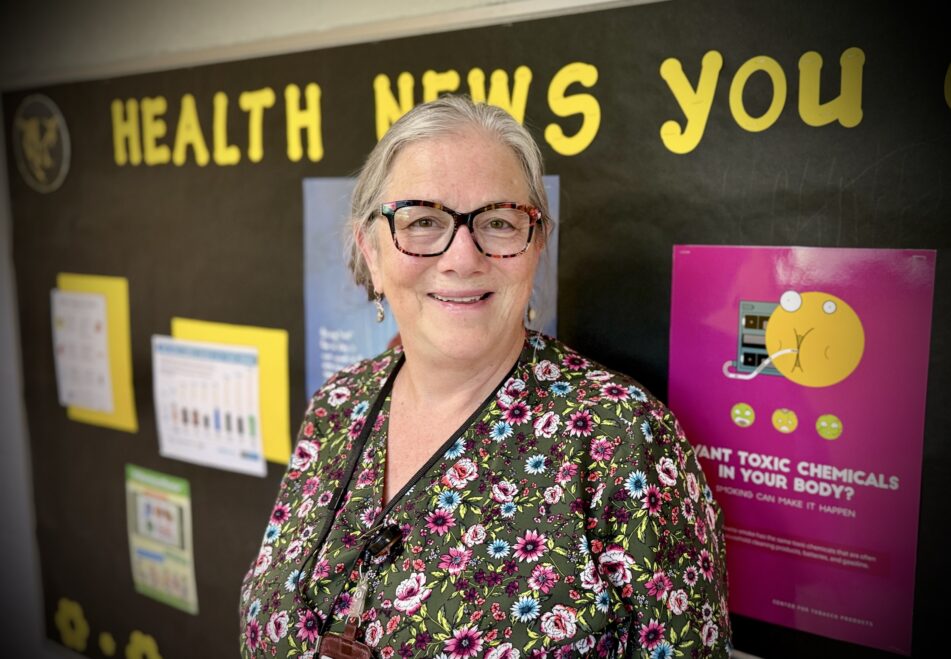
Kristin Mahler spent her childhood in Panama before attending college in Boston, where she worked for four years. She later moved to Ann Arbor to complete a Master of Public Health at the University of Michigan. She and her husband have lived in Ann Arbor for the past 40 years and have three sons and two grandchildren.
Throughout her nursing career, Mahler has served as a floor nurse, camp nurse, internal medicine office nurse, and nursing instructor before transitioning to her current role as a school nurse. She currently serves students at Pathways, Wines, and Logan.
Fellow AAPS school nurse Sharon Jakab says that Mahler brings a global perspective to her work, along with fluency in Spanish, helping families access resources, build connections, and feel genuinely supported.
“During Kristin’s 18 years as a school nurse with AAPS, she has touched the lives of countless colleagues, students, and families,” Jakab says. “Being in Kristin’s presence feels like receiving a warm hug. She has a gift for making people feel seen, heard, and valued while always considering the full picture of their lives and health.”
Jakab says it has been “humbling to witness Kristin in her element,” especially as she serves families with deep cultural understanding and compassion. She says that beyond her work with students and families, Mahler has been a valuable mentor and teammate, consistently stepping up to support others and strengthen the nursing team.
“Kristin has truly left our nursing community—and the world around her—better than she found it,” said Jakab.
What has it meant to work in Ann Arbor Public Schools for more than 18 years?
In reflecting on the past 18 years in AAPS, I have gained an understanding and appreciation for the multiple disciplines that go into public education. There are so many unsung heroes working with our students! It really does take a village to educate a child.
What do you enjoy most about supporting students’ health and well-being?
I love empowering students about their health and well-being. This involves listening to them and encouraging them to think and learn about their bodies and health.
How has the role of a school nurse changed during your career?
Over the past 18 years, I have seen the role of the school nurse expand and become more standardized both in the district and in the state. Thanks to our Michigan Association of School Nurses, we now have two State School Nurses, who work closely with the Department of Education and the Department of Health and Human Services, advocating for school nurses and their role in student health. There are now more policies and guidelines in place to support our students with chronic conditions and the caregivers, often school nurses, who support them in schools.
What are some of the biggest needs you’ve seen among students over the years?
More students are coming to school with complex medical needs, which require support to keep them safe and thriving while at school. Additionally, the need for mental health support has increased over the years. As student advocates, there is also a need to support the families of students with complex needs, and the school nurse can often be a resource to help navigate the health care system and school.
How does working as a school nurse compare to working in a hospital or other setting?
The biggest difference between school nursing and other types of nursing is that, as a school nurse, you are usually the only medical professional on site. Thankfully, the other AAPS nurses are always available for consultation and support. They are an amazing group of professionals with a vast amount of expertise. It has been an honor to work with them.
What is a memory from your time in the schools that has stayed with you?
After 18 years, there are so many good memories. I am deeply humbled that students and their families trust me with their, often intimate, medical issues. In my very first year of school nursing, a kindergartener at one of the elementary schools I was at was diagnosed with type 1 diabetes. I was privileged to work with her and her family through her elementary years, then reconnect during her high school years. Another memory that will stay with me was working with the Red Cross Club at Skyline to run a blood drive in memory of a student I had known since elementary school, who passed away from complications of Sickle Cell Disease.
What has been the most challenging and rewarding part of working across elementary and high school settings?
When I began school nursing, I worked between middle and elementary schools. While there were often times that I felt I couldn’t give enough to each of the schools due to time constraints, I really enjoyed the range of ages of the students and the ability to see the uniqueness of each of the schools. I spent many years as the nurse at Skyline, working exclusively with high school students. This past year has brought me back to working across the age spectrum, and I am reminded how much each age group can be rewarding.
What advice would you give to someone starting a career in school nursing?
When I started school nursing, my friend, who had been a school nurse for several years, told me it would take at least 5 years to feel comfortable in the role-she was right! I now tell this to all the new nurses.
What would surprise co-workers who think they know you well?
Nursing was not my first choice of a major in college.
What was your first choice, and what made you change your mind?
Special education. Then I looked at careers that incorporated science and helping people and landed on nursing.
What are you looking forward to most about retirement?
I am excited to explore new opportunities to engage with my community, travel, and spend time with my family.
What will you miss most when you retire?
I will miss the interactions with students, families, and co-workers.
Be the first to comment