

For nearly four decades, Don Packard and Maria Murphy have shaped lives at AAPS. Now their daughters are carrying on that legacy.
By Jo Mathis/AAPS News Editor
For nearly four decades, Don Packard and Maria Murphy have shaped lives across the Ann Arbor Public Schools. Now their daughters are carrying on that legacy.
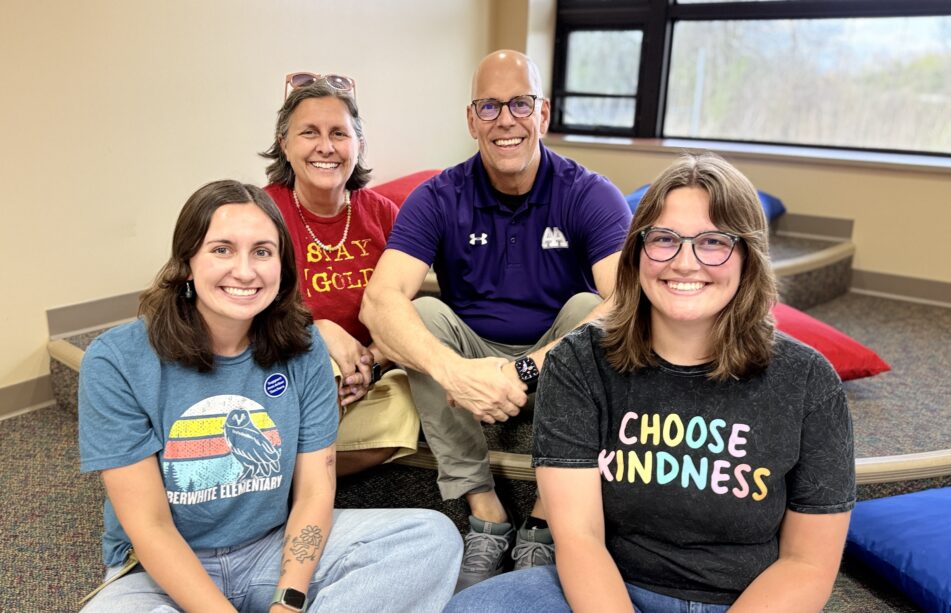
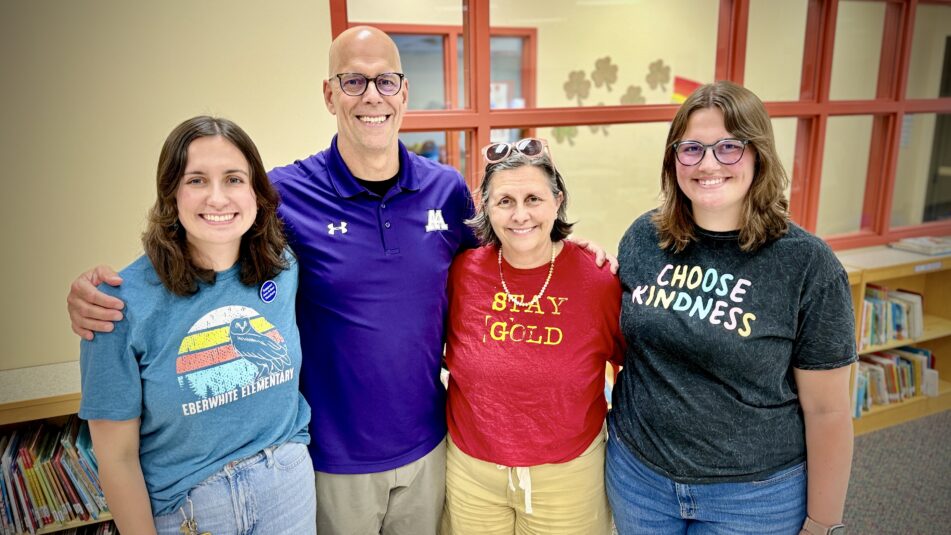
On any given school day, this AAPS family heads out for work in different directions. Don Packard drives, bikes, or walks to Pioneer High School, where he has taught English for 38 years. His wife, Maria Murphy, goes to Slauson Middle School, where she has spent 31 years teaching ELA. Their daughter Emma Packard heads for Eberwhite Elementary, where she is in her fourth year teaching second graders. And Emma’s younger sister, Maggie Packard, heads to the Westerman Preschool and Family Center, where she works as a school social worker.
It wasn’t exactly a coordinated plan, but in some ways, it feels inevitable.
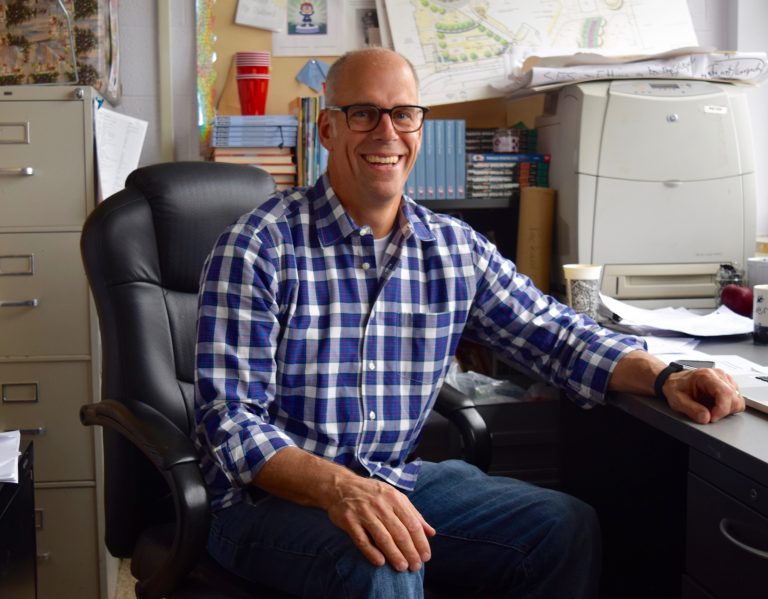
Pioneer High School for 38 years
Don Packard never planned to spend nearly four decades at a single school. He began at Pioneer, was surplussed to Huron and then Slauson, and returned to Pioneer three and a half years later.
That’s when Pioneer became home.
“I’ve been there 38 years,” he says. “I started at Pioneer at age 23 and have really grown over the years.”
When he began teaching, he used paper gradebooks and dittos. Now his classes are fully online with PowerSchool and Schoology.
One thing hasn’t changed.
“What resonates with students has always remained the same,” he says. “They want to see how they are connected to what we are reading and why it matters to their lives. The trick is staying nimble so the lessons can change as kids and their priorities change. The materials we use have become more relevant to today’s students, but the basic skills are the same.”
He’s retiring at the end of this school year, a bittersweet thought.
“I’ll miss the kids and families,” he says. “Each year, I meet wonderful new students and their parents and guardians. Over the last 38 years, I’ve met so many great people that I still run into on an almost daily basis.”
The most rewarding moments, he says, are when former students remember something from his class years later.
“I reconnected with a student at a function,” he recalls. “He said, ‘Do you remember that day when…’ It was a pivotal moment for him, and I was happy to be a small part of his growth.”
Working in the same district as his wife and daughters has also been a gift.
“It’s great to have students who have had my wife and someday my kids as teachers,” he says. “The downside is that family time is sometimes consumed by the current financial issues and teacher contract negotiations in our district.”
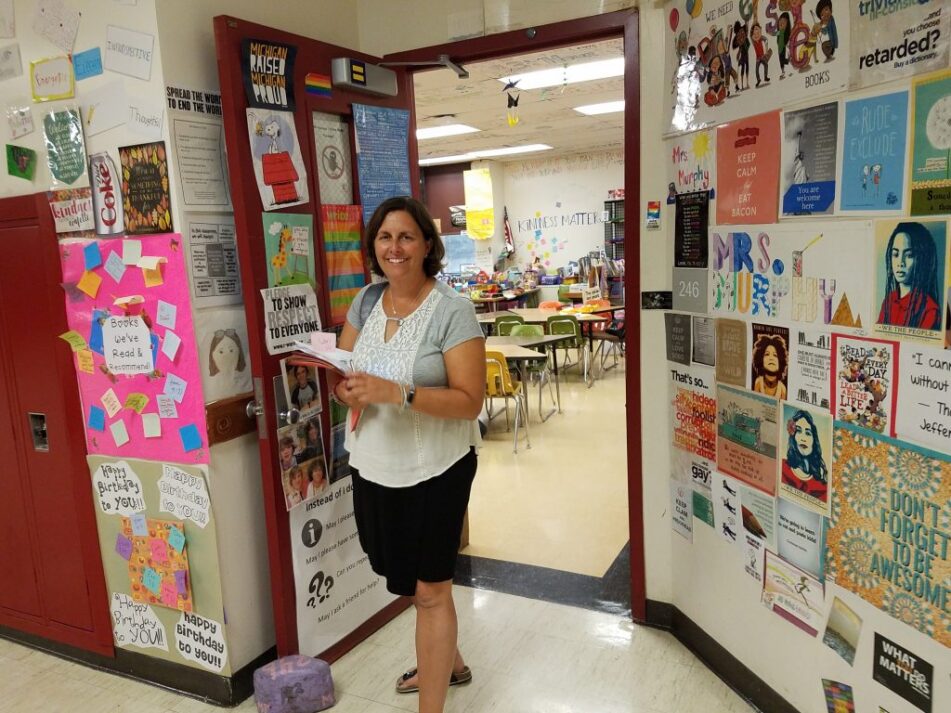
A few minutes away, in her colorfully decorated Slauson classroom, Maria Murphy is not yet ready to retire. After 31 years at Slauson, where she now chairs the English department, she still has plenty of energy.
She arrived in 1995 expecting middle school to be a stop on the way to a high school position, only to discover that adolescents were exactly the students she wanted to teach.
“Middle school students are the best,” she says. “They have the energy and enthusiasm of younger kids, but also the intellectual ability to read and discuss bigger topics and books.”
She is candid about the challenge, too.
Getting students that age to take things seriously, she notes, “can also be what’s frustrating about this age.”
But she adds, “More people should give middle schoolers a shot; they’re a fun bunch to spend your days with.”
The biggest changes over the decades have come through technology.
Students now arrive with constant access to Chromebooks, phones, and other devices, and AI has added another layer. Some of that access has helped students, she says, but some of it has made them too dependent on screens.
Maria taught all three of her children when they passed through Slauson, a fact she remembers with particular satisfaction. Her niece is also a student there now. And last year, she taught her nephew.
She has recently taught students who were once in Emma’s second-grade classroom or who already knew Emma from Eberwhite.
“It’s so fun as a parent,” she says, “to hear young people talk about my own daughter and what a difference she’s made in their educational experience.”
Coming home
Emma Packard graduated from Pioneer High School in 2018 and had little intention of becoming a teacher.
“I very much did not want to be a teacher,” she says. “I saw how much work, and sometimes how little reward, my parents put into their jobs.”
What changed her mind was not a classroom but a hallway. At Pioneer, Emma participated in the Trailblazers program, Peer Connections, and Adaptive P.E.
“I realized I truly enjoyed connecting with different people and building relationships with them,” she says, “especially kids at the elementary level and my peers with disabilities.”
She transferred to Boston University’s School of Education, earned degrees in elementary and special education, and returned to Ann Arbor in 2022.
Her first day at Eberwhite felt surreal.
“I was suddenly teaching in the same building where I attended Girl Scout meetings as a child,” she says. “I would see teachers I had in K–12 still teaching, and it was mind-boggling that we had the same job now.”
Four years in, she says the best part is watching relationships accumulate over time: seeing younger siblings come through, seeing former students check back in, and watching children grow into themselves.
“Kids are changing so much at this age,” she says, “and it’s been so fun to see them embracing their different sides, from silly to caring to curious and more.”
Emma has also been intentional about setting boundaries she didn’t always see growing up. After her second year, when she began experiencing symptoms of burnout, she decided to make a change.
“When I leave school, I try to prioritize other parts of my life outside of teaching,” she says. “I’ve found that I feel much happier and more capable of being a better, more empathetic and effective teacher when I’m prioritizing myself outside of work.”
Like her sister, Maggie came to her profession indirectly.
“As a kid, I wanted to be a teacher,” she says, “but as I got older, I found that my skills were more aligned with social work.”
School social work, she decided, was the right intersection. She initially imagined herself at an elementary school, but has found unexpected satisfaction in early childhood.
Maggie, who attended Bach, Slauson, and Pioneer, credits her parents with shaping not just her career but her character.
“My parents raised me to be someone who cares about and wants to help others,” she says. “Working with students and getting to see their growth is the most rewarding part of my job. Every student has different strengths, interests, and needs, and I really enjoy learning how best to work with them.”
The family dinner table
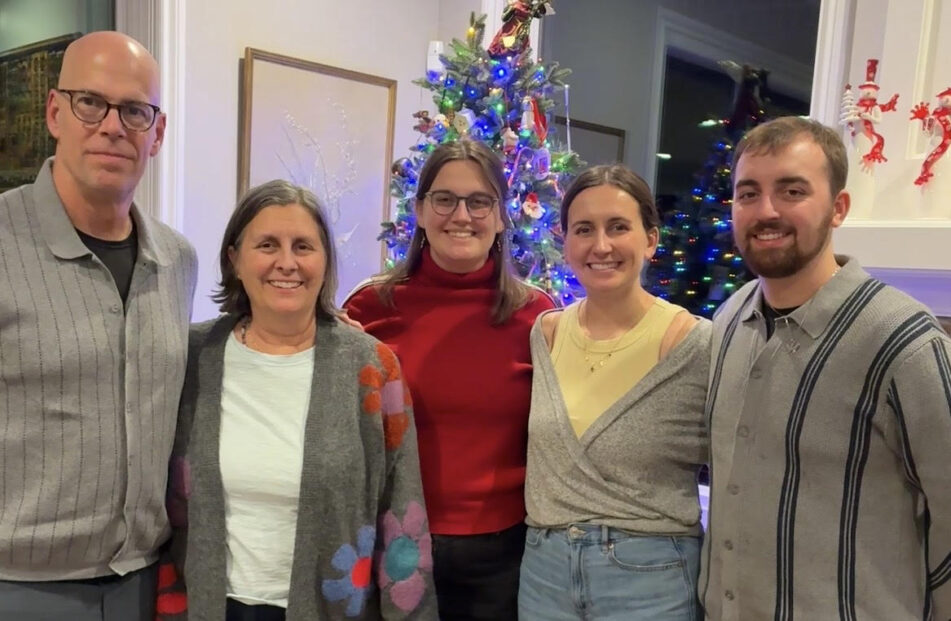
When the family gathers, the conversation often turns to school. Emma says her fiancé and her brother Luke, a marketing and supply chain major finishing his senior year at the University of Pittsburgh, have been known to drift into their own conversations or ask for a break.
“When my whole family is together, it’s even worse,” Emma says, “because my aunt is a school psychologist in AAPS, two of my cousins are students here, and my grandfather volunteers at my school.”
The overlap is especially direct between Maggie and her aunt Cathy, Maria’s sister, who is a school psychologist at Clague Middle School and Abbot Elementary.
Don says the family’s cross-grade conversations are less about pedagogy than about feeling understood.
“When we have a great or bad day, it’s good to have someone there who understands what we’re going through,” he says. “People outside education don’t always understand how those small breakthroughs with students can really make our day.”
Maria agrees.
“Many conversations in our family, even as the kids were growing up, were about our jobs in education, their experiences as students in AAPS, and the flexibility a career in education can provide, as well as the parts that are not as flexible or upwardly mobile as in other careers.”
Together, the four of them will have logged roughly 75 years in Ann Arbor Public Schools by the end of this school year.
“The question would probably be: How hasn’t the AAPS district shaped our lives?” Maria says. “It’s been part of my work life for 35 years, Don’s for even longer, and it shaped every day of our children’s K–12 experience.”
As Don gets set to retire, he has one piece of advice for his daughters: Keep going.
“Being a teacher is not an easy job,” he says. “It’s more of a lifestyle. I’m hoping they can find a home in the community where they teach and become part of that community.”
Be the first to comment