


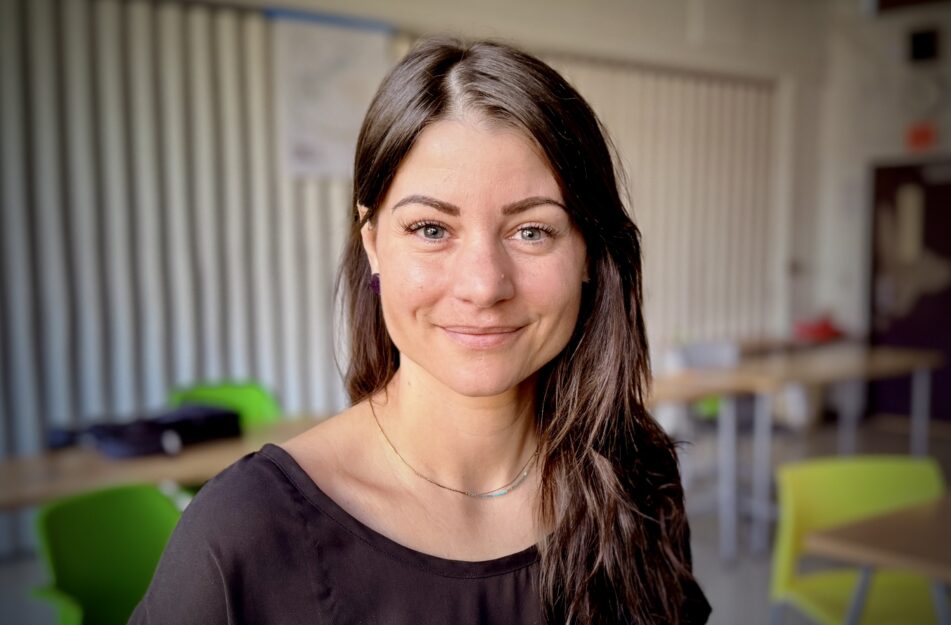
Born in Northern Michigan and raised in Boyne City, Erica Yeo grew up spending her summers swimming and her winters snowboarding. After high school, she took a few gap years to travel and live in different states, including New York, Montana, Washington, and Utah. Eventually, she made her way back to Michigan, where she completed both her undergraduate degree and master’s program at Eastern Michigan University. For the past 16 years, Yeo has called Ypsilanti home, where she has been raising her two children, Milo, 18, and Simon, 15.
Yeo began teaching in Ypsilanti in 2013, before pivoting to Detroit Public Schools, and has spent the last six years at Pathways. She says she adores her job, students, and coworkers, and has no plans to leave anytime soon.
What drew you to teaching mathematics, and what keeps you passionate about it?
My passion comes from providing students with something that wasn’t available for me: a safe space and the opportunity to learn in a way that works for them. I began teaching in 2013 and have spent my entire career (purposefully) in alternative and urban education settings. I love teaching students who find traditional education boring, unappealing, or boxed. I was one of those students. Unfortunately, when I was growing up, there weren’t the same options available for me. At Pathways, we meet kids where they are, individually, without question.
How do you approach teaching a student who believes they’re “just not a math person”?
For a long time, I believed I was “just not a math person”. It wasn’t until I was placed into remedial math in college and had to figure it out on my own that everything clicked. That experience completely shifted my perspective and showed me it’s not the math that’s difficult, it’s the way it’s taught. Teaching “struggling” math learners requires not only a deep understanding of content but, more importantly, of the disconnect between the math curriculum and students. I challenge any “not a math person” to take my class, put in effort, and not walk away understanding and learning.
What teaching strategies or methods have you found most effective for making complex math concepts click for students?
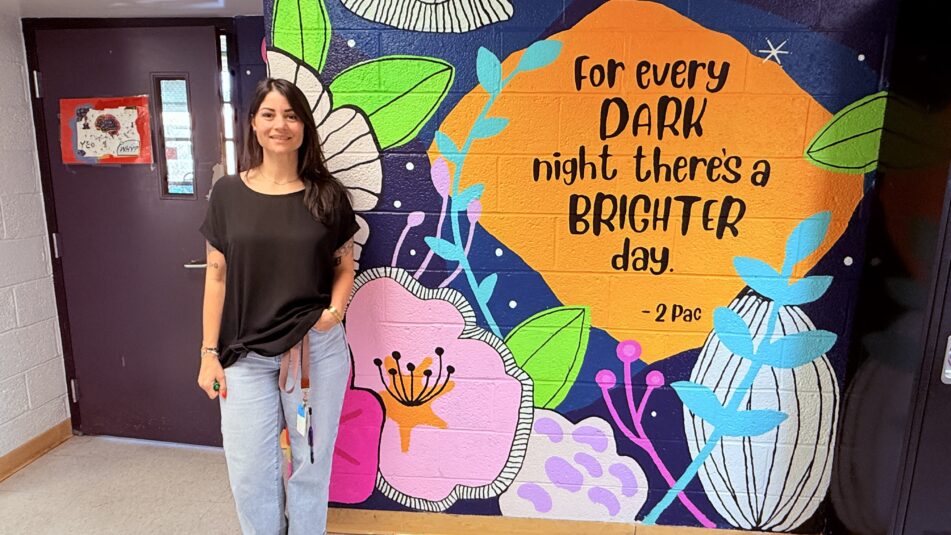
Erica Yeo stands beside a mural she painted outside her classroom.
The work completed through my master’s program certainly helped me hone in on what students need to be successful in math. My focus was primarily on increasing mathematics fluency for minority students through culturally relevant language practices. At its core, this idea is two-fold. First, mathematics is essentially a second language. Second, there is often a significant gap between the
dialects students use in everyday life and formal academic English. When you layer those challenges together, along with often out-of-touch real-world examples, it’s no surprise that many students feel discouraged and lost.
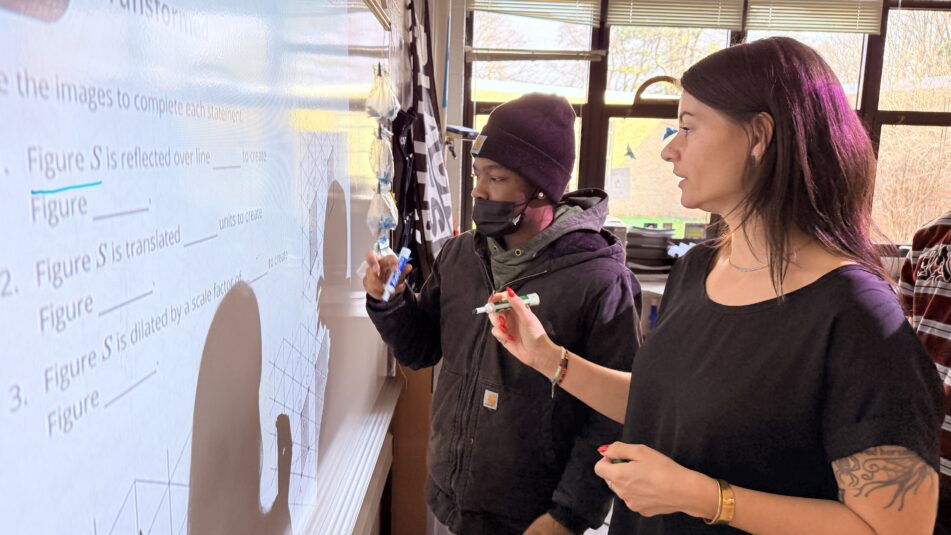
My approach to teaching complex math is grounded in the idea of “people talk vs. math talk,” a phrase coined by freedom fighter and math advocate Robert Moses. Some days, we spend time breaking down complex mathematical language by crossing out dense sentences and rewriting them in more accessible, student-friendly terms. I also reward students for asking questions or demonstrating learning on the board. You’d be surprised how far a few snacks will get them!
What does a typical day look like for you at Pathways?
There is no typical day at Pathways! Every day is different, and every day requires an adjustment based on the circumstances. While things may change, the goal stays the same. I want students to feel safe and seen when they walk in, and leave having learned something new while feeling just a little more confident in their math abilities.
What advice would you give to students and parents about how to support math learning at home?
I wish I had the magic answer for this. I have a difficult time supporting my own kids at home with math. But I will say two things: Studying or doing homework with peers is super helpful. What one kid doesn’t understand, the other will. Second, AI is a great teacher sometimes. Use it to learn it, not to do.
What is most challenging about your job?
While Pathways faces a lot of challenges, I would argue that the most challenging is the lack of adequate food provided for students. As a result, our students are constantly hungry and on a mission to find something to eat. I strongly believe that an increase in selection and quality would cancel out many of the challenges we face here, including but not limited to: consistent attendance, mental
distractions/lack of focus, interrupted instructional time due to poorly timed food deliveries or other random side quests.
What is most rewarding?
The most rewarding part of my job is seeing kids feel proud of themselves.
Be the first to comment